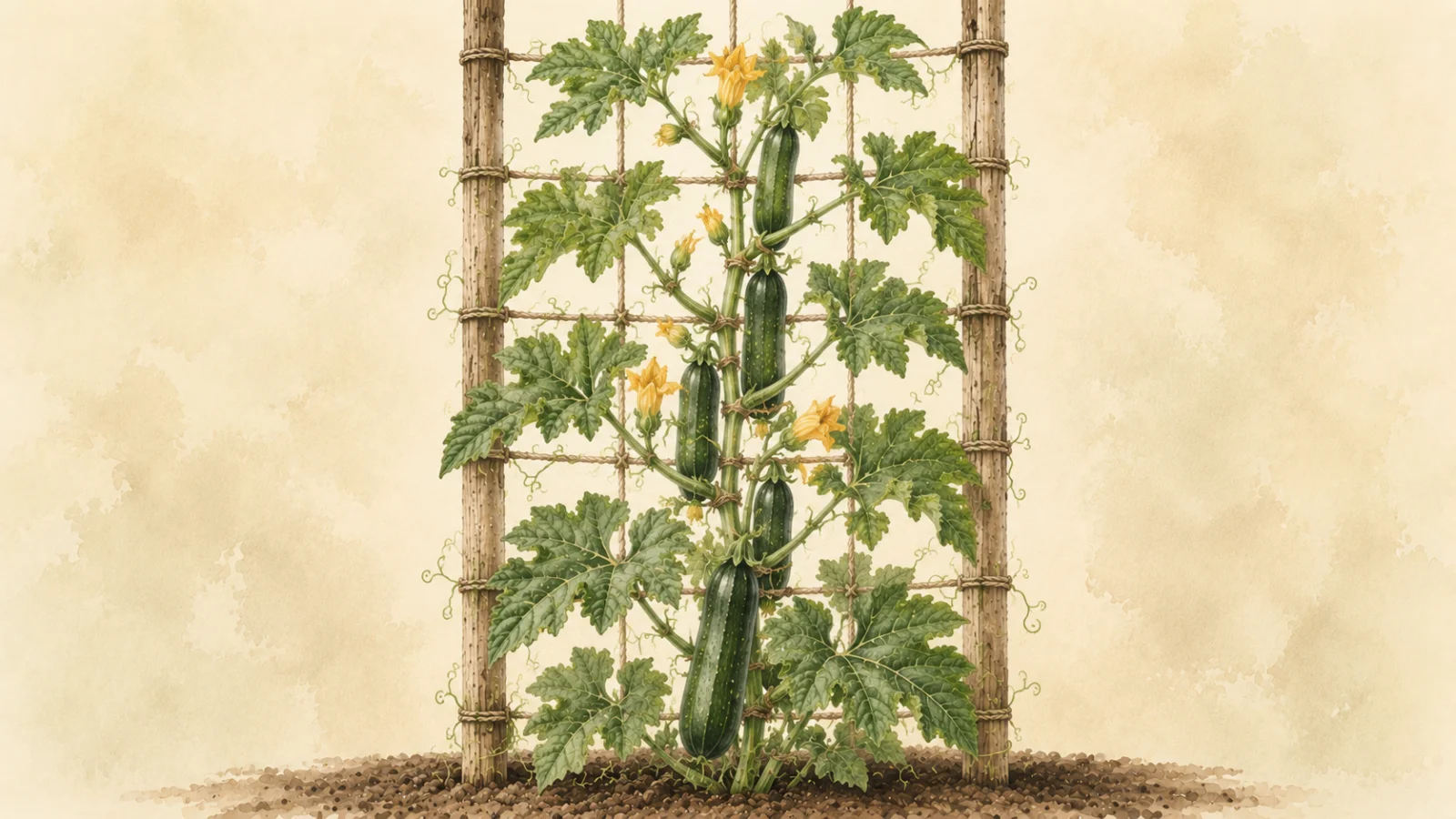
Botanical watercolor illustration of an upright-trained zucchini plant (Cucurbita pepo) growing vertically on a rustic wooden trellis, with large green leaves, yellow blossoms, and dark green zucchini fruits against a soft cream background.

Zucchini Trained Upright

Zucchini

Cucurbita pepo

Crop overview

Crop group
Cucurbit
Lifecycle
Annual
Growth habit
Bush Summer Squash With A Thick Central Stem

This profile covers bush-type zucchini manually trained and tied upright to a strong support. Zucchini does not naturally climb or attach itself to a trellis, so this method requires regular tying and leaf management. It does not cover trailing or vining summer squash, winter squash, pumpkins or compact cultivars where the seed packet gives different spacing or container guidance.

Variety examples

Black Beauty, Dunja, Cocozelle, Costata Romanesco, Golden Zucchini

Quick facts

Plant spacing
45 cm – 75 cm
Row spacing
87 cm
Support height
1.20 m – 1.80 m
Support strength
Heavy
Support types
Sturdy Stake, Multiple-Stake Frame, Heavy-Duty Cage
Training method
Sprawling Trained Up
Vertical suitability
Specialist
Sun requirement
Full Sun
Days to harvest
45–65 days

Support & training

Training requirements

Install a strong stake or frame before planting. As the central stem lengthens, lift it gently and secure it to the support with wide, soft ties below strong leaf joints. Add new ties regularly as the plant grows. Do not expect the plant to climb or cling by itself, and avoid bending a thick mature stem sharply because it can split.

Pruning requirements

Remove yellow, damaged, badly diseased or ground-level leaves with clean tools where needed for airflow and access. Cut leaf stalks close to the main stem without damaging it. Avoid stripping large amounts of healthy foliage, as the leaves feed the plant and shade developing fruit.

Growing setup guidance

Container

Minimum size: 50 L

Plants per container: 1

Grow one plant in a broad, stable container holding at least 50 L (about 13 US gal) of potting mix. Larger containers are preferable in hot, dry or windy conditions. Provide excellent drainage, consistent watering and regular feeding. Anchor the support independently or very firmly, as a tall mature plant can become top-heavy. Upright container-grown zucchini may need watering more often than plants grown in the ground.

Raised bed

Allow one plant about 60 cm of growing space beside a strong stake or frame. Install the support before planting. Maintain consistent soil moisture and leave enough room to reach the stem for tying, leaf removal and harvesting.

In-ground

Plant in fertile, moisture-retentive but well-drained soil beside an installed support. Keep the crown visible and accessible for tying and pest checks. Even when trained upright, allow adequate root space and airflow rather than crowding plants closely together.

Planting, pollination & harvest

Sowing / transplanting

Direct sow after frost danger has passed and the soil has warmed to at least 18°C (65°F), with about 21°C (70°F) preferred for reliable germination. Alternatively, start seedlings indoors about 3 weeks before planting out. Harden them off and transplant gently because squash roots dislike disturbance. Install the support before sowing or transplanting.

Pollination

Zucchini plants produce separate male and female flowers. Bees and other insects normally transfer pollen from male flowers to female flowers. Early male-only flowering is normal. Poor pollination can cause small fruit to yellow, shrivel or rot instead of developing. Hand pollination may help where pollinator activity is low. Some parthenocarpic cultivars can form fruit without pollination.

Warnings

Zucchini is very frost-tender and grows poorly in cold soil. Check regularly for squash vine borer, squash bugs, cucumber beetles, powdery mildew, downy mildew and blossom or fruit rots. Wet, humid weather can increase disease and fruit-rot pressure. Avoid insecticides while flowers are open and pollinators are active.

General notes

Harvest frequently while fruit is young, tender and glossy, before the rind hardens and seeds become large. Hold the fruit and cut the short stem rather than pulling or twisting hard against the supported plant. Remove oversized fruit because leaving it on the plant can reduce continued production.

Climate guidance

Planting season

Plant in spring after frost danger has passed and the soil has warmed. Aim for strong establishment before the hottest, driest part of summer. A later crop may be possible where warm autumn conditions are reliable.

Wet / dry season

Grow through the warm dry season with dependable irrigation. Mulch after the soil has warmed to conserve moisture. Ensure excellent drainage during wetter spring conditions.

Soil temperature

Direct sow once soil is at least 21°C (70°F). Avoid sowing into cold, saturated winter soil.

Frost sensitivity

Very frost-tender. Wait until nights are reliably mild.

Heat sensitivity

Prolonged extreme heat, very low humidity, hot winds and water stress can reduce flowering and fruit development. Consistent irrigation is especially important for upright and container-grown plants.

Humidity / disease

Dry summers can reduce some foliar diseases, although powdery mildew, mites and stressed foliage may still become troublesome later in the season.

Sowing guidance

Direct sow into warm soil or use young, carefully handled transplants. In very hot inland districts, time later plantings so flowering avoids the fiercest heat.

Notes

Protect tall trained plants from strong drying winds and make certain the support cannot loosen as the container or soil dries.

Ready to plan?

Open the planner with Zucchini Trained Upright preselected.