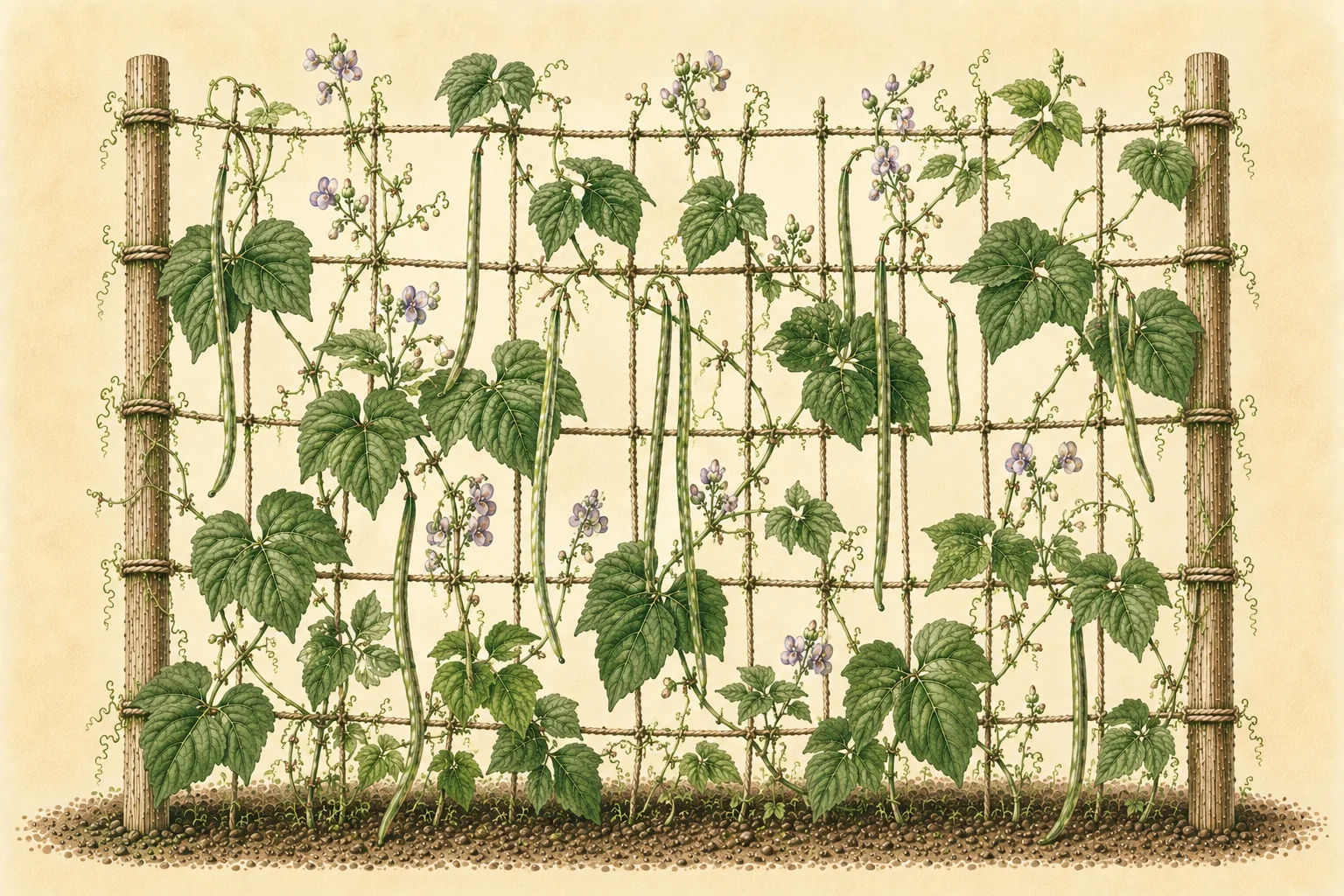
Yardlong Bean / Snake Bean
Vigna unguiculata subsp. sesquipedalis
Crop overview
- Crop group
- Legume
- Lifecycle
- Annual
- Growth habit
- Vigorous Heat-Loving Twining Vine With Long Edible Pods
This profile covers climbing cultivars of Vigna unguiculata subsp. sesquipedalis grown vertically for their tender immature pods. These beans are also commonly called snake beans, asparagus beans, Chinese long beans and long-podded cowpeas. It does not cover bush or dwarf yardlong-bean cultivars, ordinary pole snap beans, shelling cowpeas or other climbing bean species. Follow cultivar-specific guidance where pod length, maturity or day-length response differs. It does not cover ordinary common pole beans, bush cowpeas, black-eyed peas, winged beans, hyacinth beans or dwarf yardlong cultivars that do not require a full trellis. Pod length, colour and ideal harvest size vary considerably between cultivars.
Variety examples
Bia-long, Orient Wonder, Red Noodle, Python
Quick facts
- Plant spacing
- 15 cm – 30 cm
- Row spacing
- 90 cm
- Support height
- 1.80 m – 2.40 m
- Support strength
- Medium
- Support types
- Trellis Netting, Wire Trellis, Sturdy Fence, Bean Teepee, String Trellis, Garden Arch
- Training method
- Twining
- Vertical suitability
- Recommended
- Sun requirement
- Full Sun
- Days to harvest
- 50–80 days
Support & training
Training requirements
Pruning requirements
Growing setup guidance
Container
Minimum size: 30 L
Plants per container: 2
Grow up to two plants in a broad, stable container holding at least 30 L (about 8 US gal) of potting mix. A larger container provides more stable moisture during very hot weather. Provide excellent drainage and a firmly anchored trellis at planting time. Keep the potting mix consistently moist during flowering and pod development, but do not leave it waterlogged. Containers may require daily moisture checks during hot or windy weather. Feed moderately rather than applying excessive nitrogen, which can encourage leafy growth at the expense of pods.
Raised bed
In-ground
Planting, pollination & harvest
Sowing / transplanting
Pollination
Warnings
General notes
Climate guidance
Climate suitability: Recommended