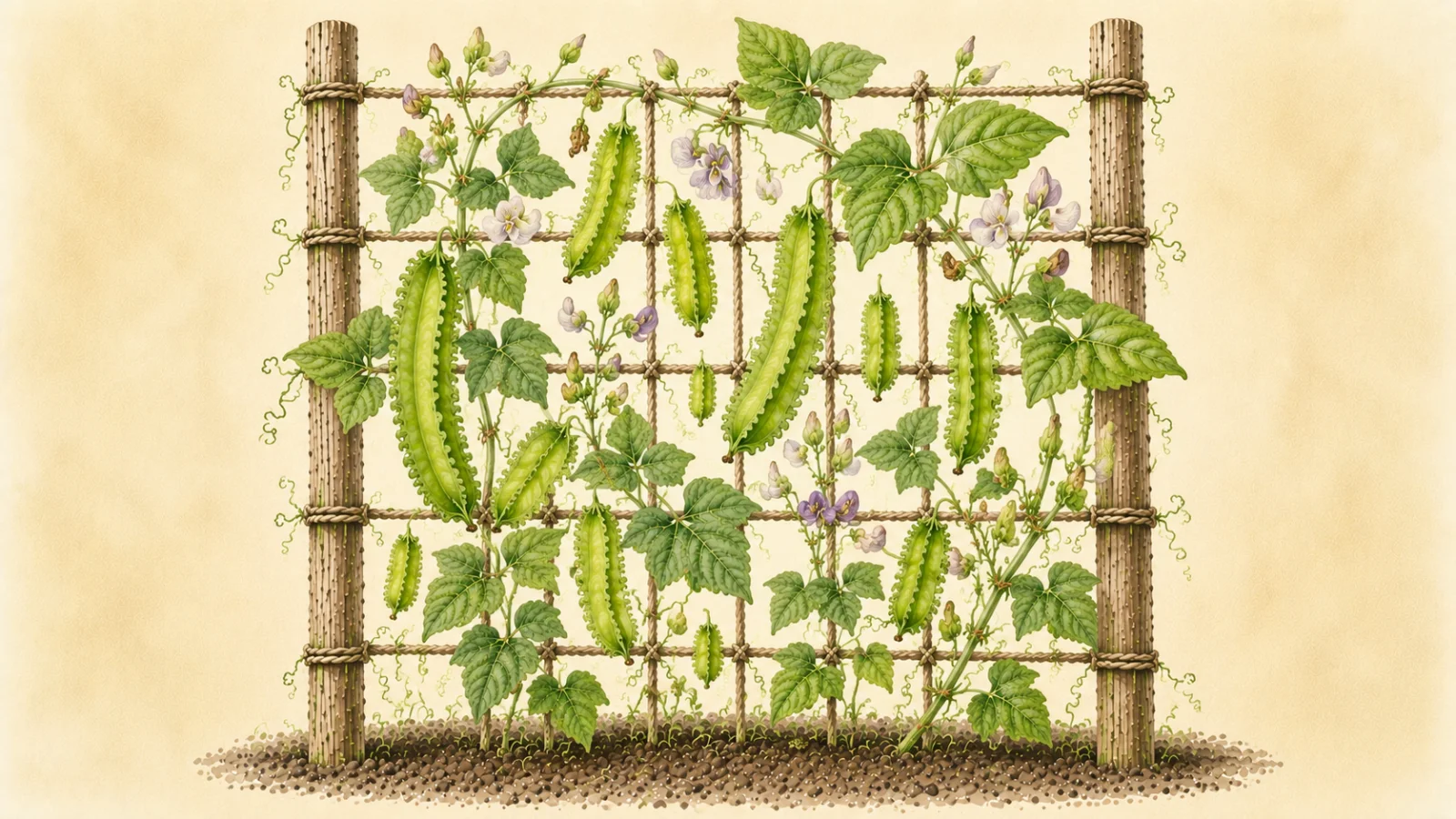
Botanical watercolor illustration of winged bean (Psophocarpus tetragonolobus) growing vertically on a rustic wooden trellis, with lush green trifoliate leaves, pale lilac flowers, curling tendrils, and multiple four-winged pods in various stages of development against a soft cream background.

Winged Bean

Winged Bean / Goa Bean

Psophocarpus tetragonolobus

Crop overview

Crop group
Legume
Lifecycle
Perennial
Growth habit
Vigorous Tropical Twining Vine With Edible Four-Winged Pods

This profile covers cultivated winged bean (Psophocarpus tetragonolobus) grown vertically, primarily for its tender immature pods and young shoot tips. It is a frost-tender tropical climbing plant that may persist as a perennial in year-round warm climates but is commonly managed as an annual vegetable crop. It does not cover asparagus pea or winged pea (Lotus tetragonolobus), which is a separate, non-climbing Mediterranean species. Many traditional cultivars require short days to initiate flowering, while day-neutral cultivars flower more reliably outside equatorial regions. This profile does not cover yardlong bean, common pole bean, hyacinth bean, yam bean or sword bean. Mature seed and tuber production have different harvest and preparation requirements and are outside the main scope of this profile.

Variety examples

Urizun, First Flight

Quick facts

Plant spacing
20 cm – 45 cm
Row spacing
90 cm
Support height
1.80 m – 2.40 m
Support strength
Heavy
Support types
Sturdy Wire Trellis, Cattle-Panel Trellis, Reinforced A-Frame Trellis, Strong Trellis Netting, Garden Arch, Sturdy Fence
Training method
Twining
Vertical suitability
Recommended
Sun requirement
Full Sun
Days to harvest
90–150 days

Support & training

Training requirements

Install the support before sowing or transplanting. Guide young vines toward the trellis and loosely tie them where necessary until the stems begin twining around the support. Redirect vigorous shoots through open sections of the trellis as they grow. The plant does not use tendrils, so provide poles, wire, string or mesh that the stems can wind around.

Pruning requirements

Pruning is optional. Redirect or shorten excessively long shoots where necessary to keep the vine within its allocated support. Harvesting tender shoot tips can encourage branching. Remove damaged, diseased or severely crowded growth as needed, but avoid heavy pruning during flowering and pod production.

Growing setup guidance

Container

Minimum size: 50 L

Plants per container: 1

Grow one plant in a broad, stable container holding at least 50 L (about 13 US gal) of potting mix. A larger container is preferable where the vine will grow through a long tropical season. Provide excellent drainage, consistent moisture and a firmly anchored trellis. Winged bean often grows slowly at first, then develops into a large, heavy vine. Feed moderately rather than applying excessive nitrogen, and do not allow the container to remain waterlogged.

Raised bed

Plant beside a completed, sturdy trellis. Raised beds are useful in high-rainfall climates because they improve drainage around the roots. Maintain consistent moisture and leave enough access for training the vine and harvesting pods frequently. Position the support where the dense growth will not overwhelm or heavily shade smaller crops.

In-ground

Plant in warm, fertile, freely draining soil beside a sturdy support. Winged bean can form nitrogen-fixing root nodules, but it still needs suitable soil fertility and should not be overloaded with nitrogen fertiliser. Avoid low areas where water remains around the roots after rain. In frost-free climates, remove unwanted regrowth or seedlings if the crop is being managed as an annual.

Planting, pollination & harvest

Sowing / transplanting

Winged-bean seed has a hard coat. Soak seed in warm water for about 12 hours and lightly scarify the seed coat before sowing to improve germination. Direct sow into thoroughly warm soil beside the installed trellis. Where the growing season is short, start seed in individual containers about 6–8 weeks before planting out, then harden seedlings gradually and transplant with minimal root disturbance. Choose a day-neutral or locally proven cultivar outside tropical short-day regions. Traditional short-day cultivars may produce abundant vine growth but flower too late for a useful harvest.

Pollination

Winged bean is predominantly self-pollinating and can normally set pods without a second variety nearby. Bees and other insects may visit the flowers, and some cross-pollination between winged-bean plants can occur. Poor pod set is more often linked to unsuitable day length, cool conditions, extreme heat or water stress than to the absence of a pollinating companion.

Warnings

Winged bean is extremely frost-tender and grows poorly in cool conditions. Traditional short-day cultivars may not begin flowering until day length approaches about 12 hours, which can result in vines failing to crop before frost in temperate regions. Avoid prolonged waterlogging. Watch for aphids, mites, thrips, bean flies, caterpillars, pod-boring insects, rusts, leaf spots, root rots and bean viruses, particularly in warm humid conditions. Pods become fibrous and stringy as they mature. This profile focuses on tender immature pods; mature dry seeds and tuberous roots require different harvest and preparation guidance.

General notes

Harvest pods while they are crisp, flexible and easy to snap, before the seeds become prominently swollen and the wings turn tough. Tender-pod size varies by cultivar, so texture is a better guide than maximum length. Pick every two or three days during active production. Frequent harvesting encourages continued flowering and prevents pods from becoming fibrous. Young leaves, shoots and flowers are also used as vegetables in some cuisines. The crop may grow slowly for its first several weeks before becoming vigorous once temperatures are consistently warm.

Climate guidance

Climate suitability: Possible

Planting season

Plant in late spring after frost danger has passed and nights and soil are reliably warm. Hot summers can support strong growth and good pod production when a day-neutral cultivar is used.

Wet / dry season

Water deeply and consistently during dry weather, especially from flowering through pod production. Avoid repeated swings between drought and saturated soil.

Soil temperature

Plant into thoroughly warm soil, preferably around 20°C (68°F) or above. Avoid rushing seedlings into cold spring ground.

Frost sensitivity

Extremely frost-tender. Treat the crop as an annual and harvest remaining tender pods before autumn frost.

Heat sensitivity

Hot summer weather generally suits winged bean. Extreme heat combined with dry soil may cause flowers or young pods to abort, so maintain even moisture.

Humidity / disease

Warm rainy periods may increase rust, leaf-spot, aphid, mite and root-disease pressure. Maintain airflow and avoid waterlogging.

Sowing guidance

Scarify and soak seed before direct sowing into warm soil, or start seedlings in individual pots about 6–8 weeks earlier. Install the support before planting.

Notes

Choose a day-neutral or locally proven early variety. Traditional short-day plants may remain vegetative until late summer or autumn and then run out of warm weather.

Ready to plan?

Open the planner with Winged Bean preselected.