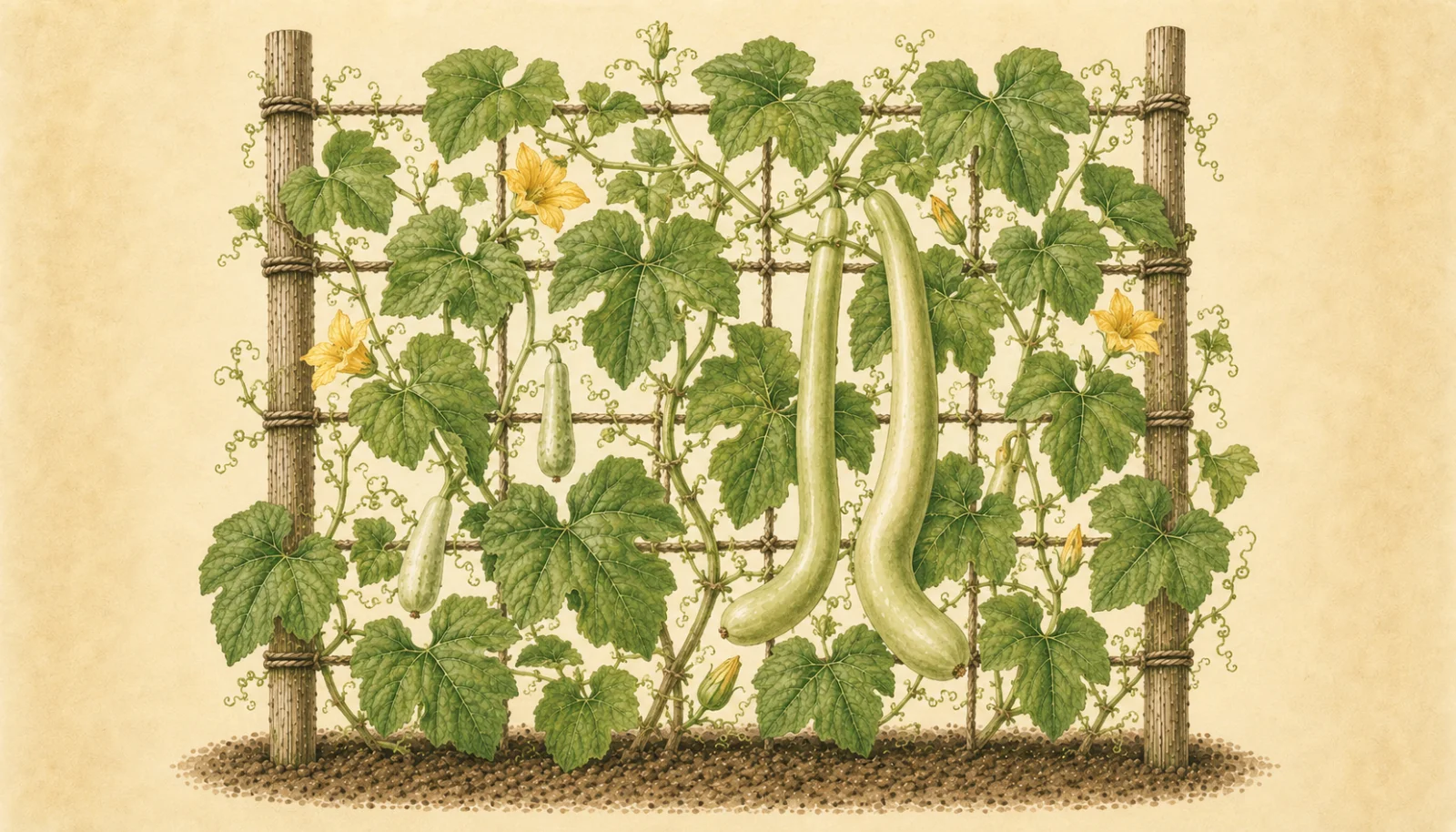
Botanical watercolor illustration of tromboncino squash (Cucurbita moschata) climbing a rustic wooden trellis, with broad lobed leaves, curling tendrils, yellow flowers, and long pale green curved fruits at different stages of development against a soft cream background.

Tromboncino / Climbing Summer Squash

Tromboncino / Trombetta / Climbing Zucchini

Cucurbita moschata

Crop overview

Crop group
Cucurbit
Lifecycle
Annual
Growth habit
Vigorous Climbing Vine With Tendrils And Long Curved Fruit

This profile covers tromboncino, trombetta and rampicante-type Cucurbita moschata squash grown vertically and harvested primarily while young and tender as a summer squash. It includes cultivars commonly sold as Tromboncino, Trombetta di Albenga, Climbing Trombetta, Zucchetta Rampicante and Rampicante-Tromboncino. It does not cover bush zucchini, ordinary crookneck summer squash, standard butternut squash or unrelated bottle gourds. Fruit may also be left to mature into a tan, hard-rinded winter squash, but the main planner guidance is for repeated young-fruit harvest.

Variety examples

Tromboncino, Trombetta di Albenga, Rampicante-Tromboncino, Zucchetta Rampicante, Climbing Trombetta

Quick facts

Plant spacing
60 cm – 90 cm
Row spacing
1.50 m
Support height
1.80 m – 2.40 m
Support strength
Extra Heavy
Support types
Cattle-Panel Arch, Extra-Heavy Welded-Wire Trellis, Reinforced Pergola, Sturdy Garden Arch, Heavy Permanent Fence
Training method
Tendril
Vertical suitability
Recommended
Sun requirement
Full Sun
Days to harvest
58–80 days

Support & training

Training requirements

Install an extra-heavy trellis, cattle-panel arch, pergola or strongly braced fence before planting. Guide young vines onto the support and loosely secure them until tendrils attach. Spread vigorous lateral growth across open sections of the structure. Keep developing fruit hanging freely so it grows straighter and remains easy to harvest. Where fruit is being retained to full winter-squash maturity, check stems and trellis loading regularly and support unusually heavy fruit with a breathable sling if needed.

Pruning requirements

Pruning is optional. Redirect excessive growth and remove damaged, diseased or severely crowded vines where necessary for airflow and access. Avoid heavy pruning because productive flowers and fruit form along active lateral growth. Once the vine reaches the top or end of the support, its tip may be redirected or pinched to keep the plant manageable. Frequent young-fruit harvest is more important than pruning for maintaining continued production.

Growing setup guidance

Container

Minimum size: 60 L

Plants per container: 1

Grow one plant in a broad, stable container holding at least 60 L (about 16 US gal) of potting mix. Larger containers are preferable because the vine is vigorous and moisture demand increases rapidly once fruiting begins. Provide excellent drainage, regular feeding, consistent moisture and a firmly anchored extra-heavy trellis. Do not rely on a lightweight pot-mounted support. Train the vine frequently and allow long fruit to hang freely. Fruit kept to full winter-squash maturity may become heavy and should be supported where the stem or trellis is under strain.

Raised bed

Plant beside a completed, strongly braced trellis or arch. Allow substantial root space and position the support where the vigorous canopy will not overwhelm shorter crops. Maintain even moisture from flowering through fruit enlargement. Leave clear access for frequent harvesting because young fruit can grow past the tender stage quickly. Raised beds are useful where drainage is poor, but they may dry rapidly during hot weather.

In-ground

Plant in fertile, organic-rich and freely draining soil beside an installed support. Allow normal vining-squash root space even though the stems are trained vertically. Mulch after the soil has warmed and water deeply during dry periods. Avoid repeatedly wetting the foliage and do not keep the root zone saturated. Provide enough clearance for long fruit to hang without touching the ground or becoming trapped within mesh.

Planting, pollination & harvest

Sowing / transplanting

Direct sow after frost danger has passed when the soil has warmed to at least about 18°C (65°F), with warmer soil preferred. For an earlier crop, start seedlings in individual containers about 3–4 weeks before planting out. Harden them gradually and transplant carefully because squash roots dislike disturbance. Sow approximately 2.5–4 cm deep or follow the seed packet. Install and brace the permanent trellis before sowing or transplanting.

Pollination

Tromboncino produces separate male and female flowers on the same vine. Bees, including specialist squash bees where present, and other insects normally transfer pollen. The first flowers are often male and naturally fall without forming fruit. Poor pollination can cause young fruit to yellow, shrivel or stop growing. Avoid insecticides while flowers are open. Hand pollination in the morning may help where pollinator activity is low or weather repeatedly interferes with fruit set.

Warnings

Tromboncino is very frost-tender and needs warm soil. Cold conditions slow growth and may cause seed or root disease. The vine is much larger than an ordinary bush zucchini and can overwhelm lightweight structures or nearby crops. Mature fruit can become long and heavy. Watch for squash bugs, cucumber beetles, aphids, mites, caterpillars, powdery mildew, downy mildew, bacterial diseases, anthracnose, mosaic viruses and root rots. Cucurbita moschata is often less vulnerable to squash vine borer than Cucurbita pepo, but it is not immune to all pests. Stems and leaves can be coarse or prickly. Wear gloves if skin is sensitive. Do not eat fruit with an unusually strong or unpleasant bitter taste. Spit it out and discard the fruit.

General notes

For summer-squash use, harvest while the skin is tender enough to mark easily with a fingernail and before the seed cavity becomes firm. Many gardeners pick fruit around 15–30 cm long, although longer fruit can remain tender depending on cultivar and conditions. Cut fruit from the vine with a short stem attached. Pick several times each week during active production. Fruit may be left to mature into a tan, hard-rinded winter squash. Mature fruit takes considerably longer than the young-harvest range and should be cut only after the rind hardens and colour fully develops. Trellising encourages straighter fruit and makes the long vines and harvest easier to manage.

Climate guidance

Climate suitability: Recommended

Planting season

Plant in spring after frost danger has passed and the soil has warmed. Establish early enough to use the full hot summer.

Wet / dry season

Water deeply and consistently during flowering and fruit enlargement. Avoid repeated swings between drought and saturation.

Soil temperature

Plant when soil is at least about 18°C (65°F). Do not rush seedlings into cold spring ground.

Frost sensitivity

Very frost-tender. Harvest remaining young fruit and mature storage fruit before autumn frost.

Heat sensitivity

Warm summers generally suit the crop. Prolonged temperatures above about 32–35°C combined with dry soil can reduce pollination and fruit set.

Humidity / disease

Hot rainy periods may increase mildew, bacterial disease, aphids, mites and fruit rot. Maintain airflow and drainage.

Sowing guidance

Direct sow into warm soil or transplant seedlings started 3–4 weeks earlier. Install the support before planting.

Notes

The crop may continue producing after ordinary zucchini declines from vine-borer damage, but inspect for other pests and diseases.

Ready to plan?

Open the planner with Tromboncino / Climbing Summer Squash preselected.