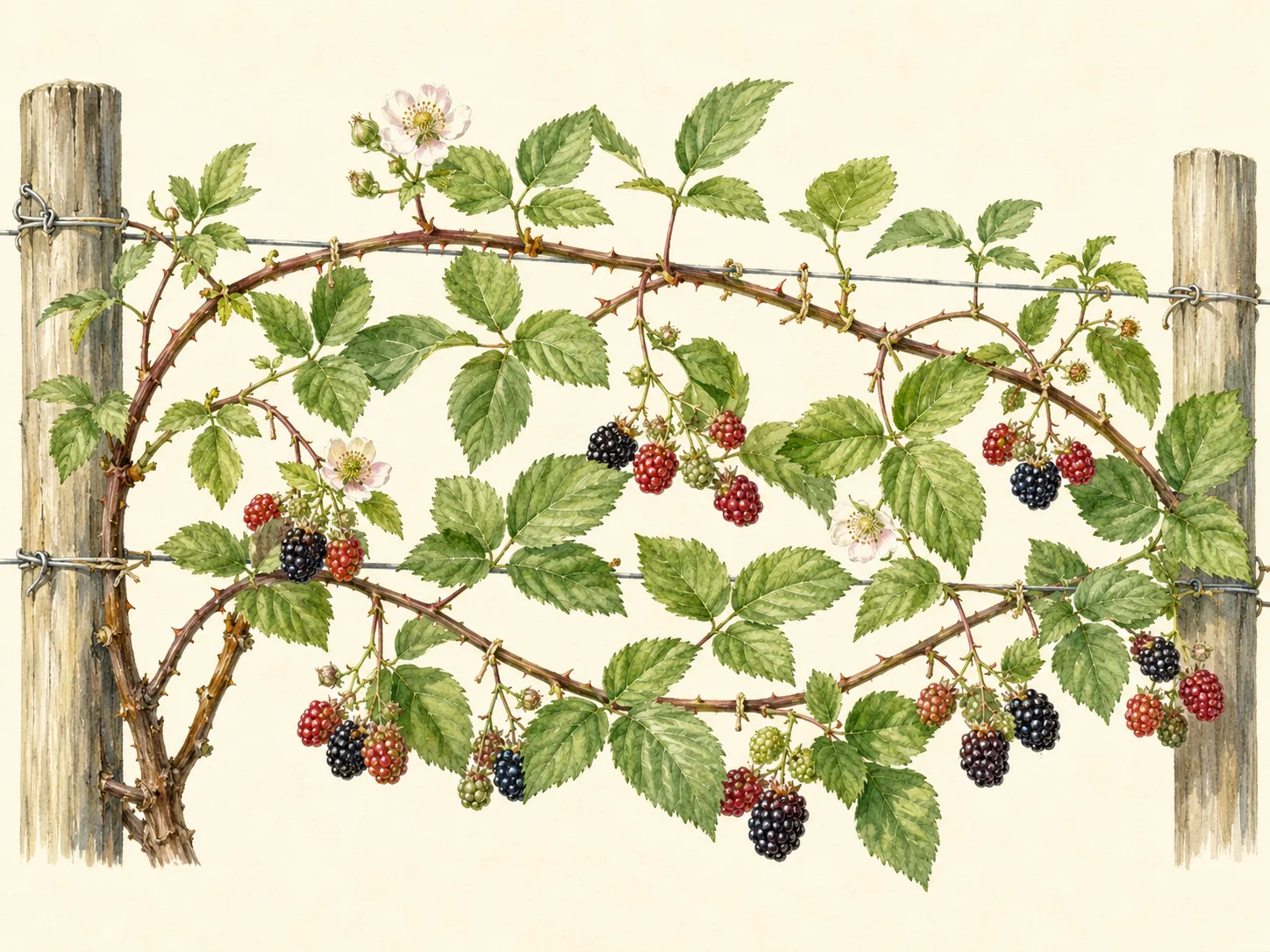
Trellised Blackberry / Boysenberry
Trellised Blackberry / Boysenberry / Trailing Caneberry
Rubus spp. and hybrids
Crop overview
- Crop group
- Cane Fruit
- Lifecycle
- Perennial
- Growth habit
- Perennial Crown Producing Long Biennial Canes That Are Tied And Trained Along Horizontal Trellis Wires
General trellised profile for trailing and semierect blackberries and blackberry-raspberry hybrids such as boysenberry. Erect dwarf container blackberries can require different spacing and pruning.
Variety examples
Boysenberry, Marionberry, Loganberry, Trailing blackberry, Thornless semierect blackberry
Quick facts
- Plant spacing
- 90 cm – 1.50 m
- Row spacing
- 3 m
- Support height
- 1.35 m – 1.80 m
- Support strength
- Medium
- Support types
- Two-Wire Trellis, T-Trellis, Double-T Trellis, Strong Wire Fence
- Training method
- Tying
- Vertical suitability
- Recommended
- Sun requirement
- Full Sun
Support & training
Training requirements
Tie fruiting canes to trellis wires and keep new primocanes organised separately where possible. Trailing cultivars require support because the canes are not self-supporting.
Pruning requirements
After harvest remove the spent floricanes at the crown, then train the new primocanes that will fruit the following season. Training method varies between trailing and semierect types.
Growing setup guidance
Container
Minimum size: 50 L
Plants per container: 1
Use a large container with a sturdy trellis and a compact or manageable cultivar. Vigorous boysenberry and trailing types still need substantial cane space.
Raised bed
Plant at the trellis edge in fertile, well-drained soil. Keep the crown clear and make sure canes can be reached for annual removal and retraining.
In-ground
Plant in full sun in well-drained soil and run canes along strong wires. Leave enough row length for the vigorous new primocanes produced each season.
Planting, pollination & harvest
Sowing / transplanting
Plant certified disease-free nursery plants in spring where winters are cold, or during the mild dormant season in suitable climates.
Pollination
Most garden blackberry and boysenberry cultivars can set fruit with one plant, but insect pollination improves fruit development and yield.
Warnings
Some cultivars are thorny and extremely vigorous. Trailing types can produce canes 4.5-6 m long, so provide enough trellis length and prune annually.
General notes
Boysenberry is treated as a trailing blackberry-type hybrid in OSU guidance. Trailing blackberries need a trellis and are commonly spaced around 0.9-1.5 m apart.
Climate guidance
Climate suitability: Possible
Planting season
Plant in early spring
Northern hemisphere months
Mar-Apr
Southern hemisphere months
Sep-Oct
Wet / dry season
Irrigate during fruit fill and prolonged summer heat.
Soil temperature
Plant before vigorous spring growth.
Frost sensitivity
Trailing types may suffer cane injury in severe winter cold.
Heat sensitivity
Mulch and water through extreme heat.
Humidity / disease
Keep canes open and fruit dry where possible.
Sowing guidance
Select a cultivar for both winter hardiness and summer heat.
Notes
Erect or semierect blackberries may be safer than boysenberry in very cold districts.