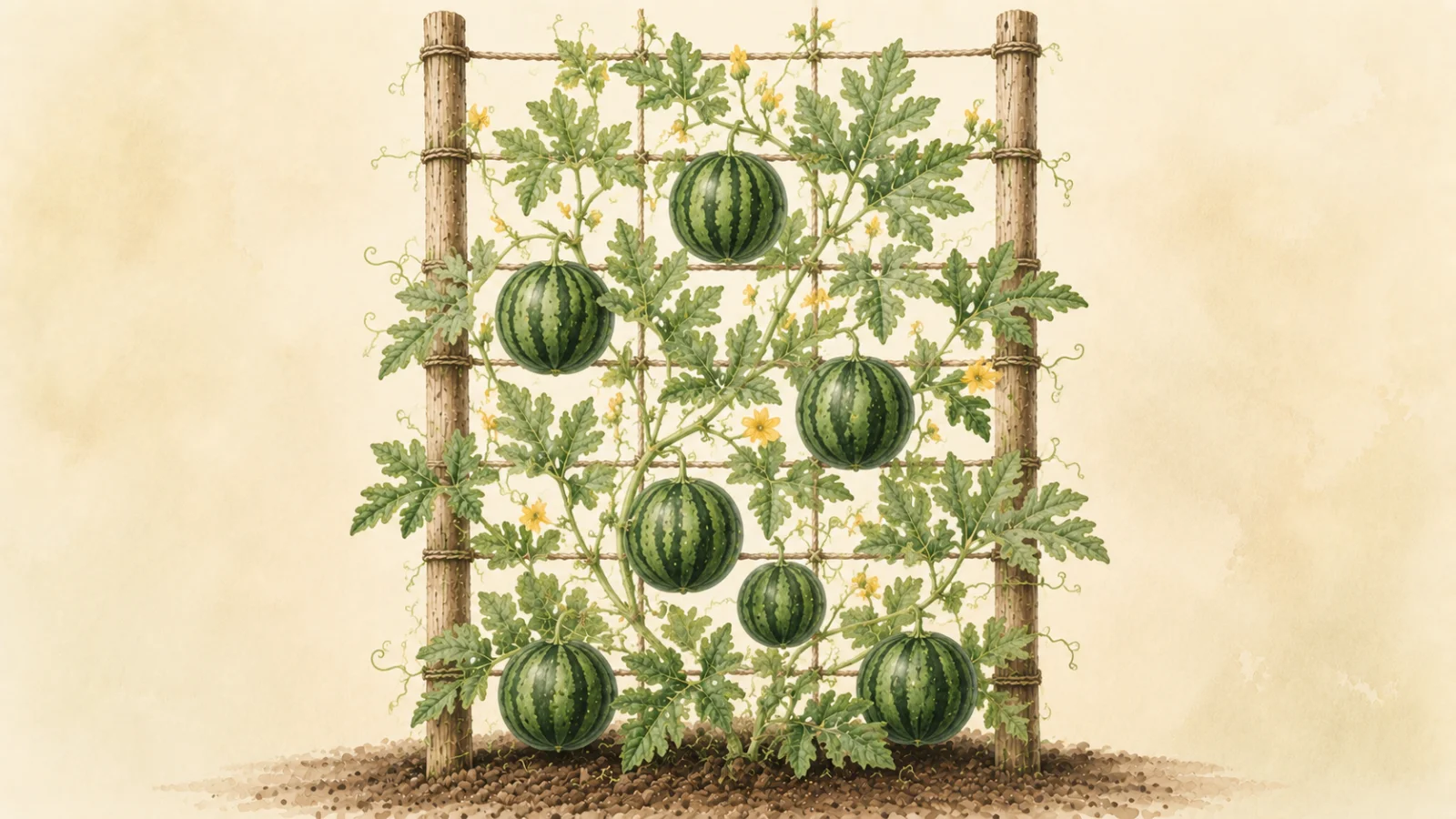
Botanical watercolor illustration of a small-fruited watermelon vine (Citrullus lanatus) growing vertically on a rustic wooden trellis, with lobed green leaves, yellow flowers, curling tendrils, and several striped mini watermelons against a soft cream background.

Small-Fruited Watermelon (Trellised)

Watermelon

Citrullus lanatus

Crop overview

Crop group
Cucurbit
Lifecycle
Annual
Growth habit
Vigorous Trailing Vine With Tendrils

This profile covers small-fruited personal-size or icebox watermelon cultivars trained vertically on a very strong trellis, with every developing fruit supported in a sling. It does not cover giant or large-fruited watermelons, unsupported hanging fruit, or compact bush cultivars grown without vertical training. Seedless cultivars require compatible pollen-producing plants nearby and additional planning.

Variety examples

Sugar Baby, Mini Love, Yellow Baby, Golden Midget

Quick facts

Plant spacing
60 cm – 90 cm
Row spacing
1.80 m
Support height
1.80 m – 2.40 m
Support strength
Extra Heavy
Support types
Cattle-Panel Trellis, Cattle-Panel Arch, Heavy Welded-Wire Panel, Reinforced A-Frame Trellis, Sturdy Pergola Trellis
Training method
Tendril
Vertical suitability
Specialist
Sun requirement
Full Sun
Days to harvest
70–95 days

Support & training

Training requirements

Install and brace the support before planting. Guide young vines onto the trellis and weave or loosely tie them into place until their tendrils hold securely. Support every developing watermelon in a breathable, quick-drying sling attached to the trellis before the fruit becomes heavy. Check slings and attachment points regularly as fruit enlarges.

Pruning requirements

Pruning is optional and should be conservative. Remove damaged or badly diseased growth where needed and redirect excessive vines to keep the plant manageable. Avoid removing large amounts of healthy foliage, which supplies energy and protects fruit from sun exposure.

Fruit slings

Slings recommended to support heavy fruit.

Growing setup guidance

Container

Minimum size: 75 L

Plants per container: 1

Grow one compact, small-fruited cultivar in a broad, stable container holding at least 75 L (about 20 US gal) of potting mix. The support should be independently anchored rather than relying on the container alone for stability. Provide excellent drainage, consistent watering and regular feeding. Support every fruit in a sling and expect the container to dry quickly during hot or windy weather.

Raised bed

Plant beside a very strong support installed before planting. Allow ample root space and position the trellis where vigorous vines will not overwhelm nearby crops. Maintain consistent moisture during establishment and fruit enlargement, and provide access to inspect ties, slings and developing fruit.

In-ground

Plant in fertile, warm, freely draining soil beside a fully installed and braced support. Allow plenty of root space even though the vines are trained vertically. Mulch after the soil has warmed, water deeply during establishment and fruit expansion, and avoid waterlogged ground.

Planting, pollination & harvest

Sowing / transplanting

Direct sow after frost danger has passed when the soil has warmed to at least 18°C (65°F), with warmer soil preferred for quick establishment. For an earlier crop, start seedlings indoors about 3 weeks before planting out. Harden them off and transplant carefully because watermelon roots dislike disturbance. Install the trellis before sowing or transplanting.

Pollination

Watermelon plants produce separate male and female flowers and rely heavily on bees and other insects to transfer pollen. Poor pollination can cause fruit to fail or develop unevenly. Seedless triploid watermelon cultivars require a compatible seeded diploid cultivar nearby to provide viable pollen. Avoid insecticide use while flowers are open and pollinators are active.

Warnings

Watermelon is very frost-tender and performs poorly in cold soil. Trellised fruit can tear vines or fall if slings or supports fail. Watch for cucumber beetles, aphids, mites, squash bugs, wilts, anthracnose, powdery mildew, downy mildew and virus diseases. Waterlogging, irregular watering and excessive nitrogen can reduce plant health or fruit quality.

General notes

Watermelon does not continue ripening after harvest. Signs of maturity include a brown, drying tendril nearest the fruit and a rind that has become dull rather than glossy. Ground-grown fruit commonly develops a creamy yellow ground spot, but this sign may be absent or less useful on suspended fruit. Cut the stem rather than pulling the melon from the vine.

Climate guidance

Planting season

Plant in spring after frost danger has passed and the soil has warmed. Plant early enough for fruit to mature before autumn frost, but do not rush plants into cold soil.

Wet / dry season

Mulch after the soil is thoroughly warm and irrigate deeply during dry periods. Avoid sharp swings between drought and saturated soil.

Soil temperature

Plant when soil is at least 18°C (65°F). Warmer soil gives faster establishment and reduces the risk of seed or root problems.

Frost sensitivity

Very frost-tender. Do not plant outdoors while frost remains likely, and harvest mature fruit before damaging autumn cold.

Heat sensitivity

Watermelon suits hot summers, but extreme heat combined with dry soil can reduce vine health, pollination and fruit quality. Maintain deep, consistent watering during flowering and fruit enlargement.

Humidity / disease

Hot, wet periods can encourage anthracnose, gummy stem blight, downy mildew and other diseases. Provide airflow, use resistant cultivars and avoid unnecessary overhead watering.

Sowing guidance

Direct sow into warm soil or use young transplants started about 3–4 weeks earlier. Install the trellis before planting and remove row covers when flowers open.

Notes

Use a cultivar with enough time to mature before the expected first autumn frost. Check fruit slings frequently as melons gain weight.

Ready to plan?

Open the planner with Small-Fruited Watermelon (Trellised) preselected.