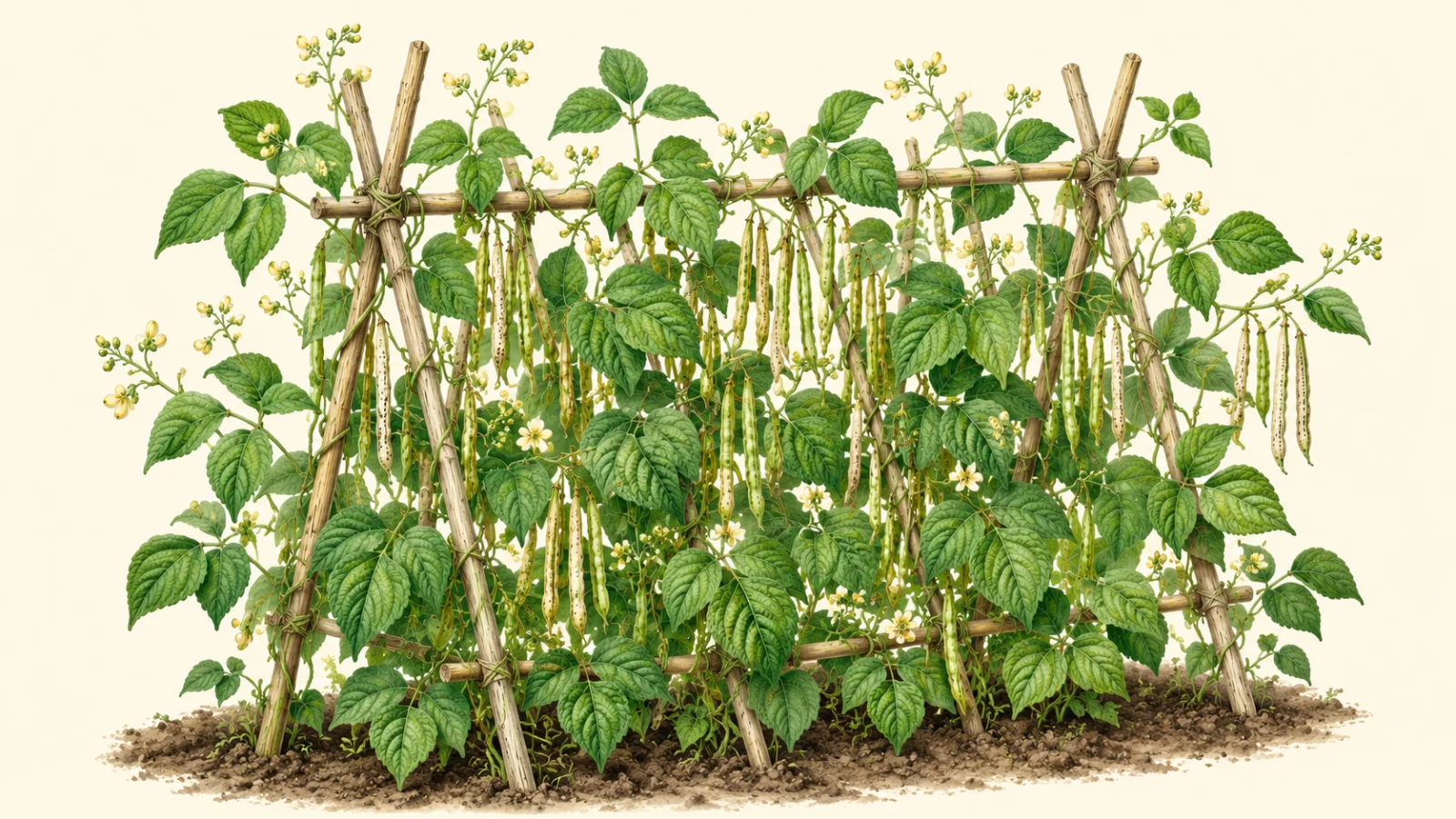
Botanical illustration of a rice bean vine growing around a wooden support, with trifoliate green leaves, pale yellow flowers, green pods and mature drying pods.

Rice Bean

Rice Bean / Climbing Mountain Bean

Vigna umbellata

Crop overview

Crop group
Legume
Lifecycle
Annual
Growth habit
Warm-Season Twining Or Scrambling Vine Grown Mainly For Dry Edible Seed

This profile covers climbing or twining forms of rice bean (Vigna umbellata) trained vertically and grown mainly for their small edible dry seeds. It includes locally selected grain landraces also sold as ricebean or climbing mountain bean. It does not cover adzuki bean, mung bean, cowpea, yardlong bean or other Vigna species. Follow seed-source guidance because growth habit, flowering response and maturity can vary between landraces. Some forms are compact or scrambling rather than strongly climbing; choose a vining cultivar for a vertical garden. Traditional landraces may require days shorter than about 12 hours to flower and can remain vegetative under long days. It does not cover adzuki bean, mung bean, cowpea, yardlong bean or rice.

Quick facts

Plant spacing
30 cm – 60 cm
Row spacing
90 cm
Support height
1.50 m – 2.40 m
Support strength
Medium
Support types
Trellis Netting, Wire Trellis, String Trellis, Sturdy Fence, A-Frame Trellis
Training method
Twining
Vertical suitability
Specialist
Sun requirement
Full Sun
Days to harvest
90–150 days

Support & training

Training requirements

Guide young scrambling or twining stems onto mesh, wire or string. Loosely tie them until they remain on the support. Redirect growth across open trellis space and prevent stems from forming an inaccessible mat near the ground.

Pruning requirements

Routine pruning is generally unnecessary. Redirect tangled growth and remove damaged, diseased or severely crowded stems. Avoid heavy pruning after flowering begins. Dry-pod harvesting and good airflow are more important than shaping.

Growing setup guidance

Container

Minimum size: 40 L

Plants per container: 1

Grow one vigorous plant in a stable container holding at least 40 L (about 10.5 US gal) of potting mix. A larger container gives more reliable moisture and seed filling. Provide a firmly anchored trellis and excellent drainage. Maintain moisture through flowering and pod filling, then allow the crop to dry as pods mature. Container production is specialist because cultivars vary in climbing habit and day-length response.

Raised bed

Plant beside an installed support in freely draining soil. Raised beds are valuable in high-rainfall climates because rice bean is harmed by prolonged waterlogging. Allow airflow around the vine and access for collecting dry pods before they shatter or become wet.

In-ground

Direct sow into warm, freely draining soil beside a trellis. Rice bean can grow in relatively low-fertility or acid soils, but adequate phosphorus, potassium and moisture improve seed production. Avoid low ground and saturated soil. As a legume, the crop may form nitrogen-fixing nodules when compatible rhizobia are present.

Planting, pollination & harvest

Sowing / transplanting

Direct sow after frost danger when soil and nights are warm, preferably with soil at least about 18°C (65°F). Install the support at sowing time. Plant seed approximately 2.5–4 cm deep according to soil texture and local guidance. Choose an early or day-neutral cultivar outside tropical and subtropical short-day regions. Traditional landraces may produce abundant vines but little seed under long summer days.

Pollination

Rice bean is generally self-pollinating and can normally produce seed without another variety nearby. Insects may visit the yellow flowers and occasional crossing can occur. Day length and temperature are often more important limitations on flowering than pollinator presence.

Warnings

Rice bean is frost-tender and requires warm conditions. Many traditional forms are short-day responsive and may flower too late for a temperate harvest. Avoid prolonged waterlogging. Watch for aphids, bean flies, caterpillars, pod borers, storage bruchids, rusts, leaf spots, root rots and legume viruses. Dry rice beans should not be eaten raw. Soak and cook the mature seeds thoroughly using reliable pulse-preparation guidance.

General notes

Harvest dry beans when pods are brown and dry and seeds are firm. Collect pods promptly because some landraces may shatter when fully dry. If rain threatens, harvest mature pods and finish drying under cover. Shell only when beans are thoroughly dry and store them in a cool, dry place. Rice bean is primarily a pulse crop rather than a snap bean. Young pods and leaves are used in some regions, but this profile focuses on mature seed. Cook dry seed thoroughly before eating.

Climate guidance

Climate suitability: Possible

Planting season

Plant after frost danger when soil and nights are warm. Hot summers support growth if flowering begins early enough.

Wet / dry season

Water during flowering and seed filling, then allow pods to dry.

Soil temperature

Plant into soil at least about 18°C (65°F).

Frost sensitivity

Extremely frost-tender.

Heat sensitivity

Hot weather generally suits growth, but drought can reduce seed set.

Humidity / disease

Hot rain can increase leaf spots, rust and root disease.

Sowing guidance

Direct sow beside the support. Choose early or day-neutral seed.

Notes

Short-day landraces may not flower until late summer or autumn and can run out of warm weather.

Ready to plan?

Open the planner with Rice Bean preselected.