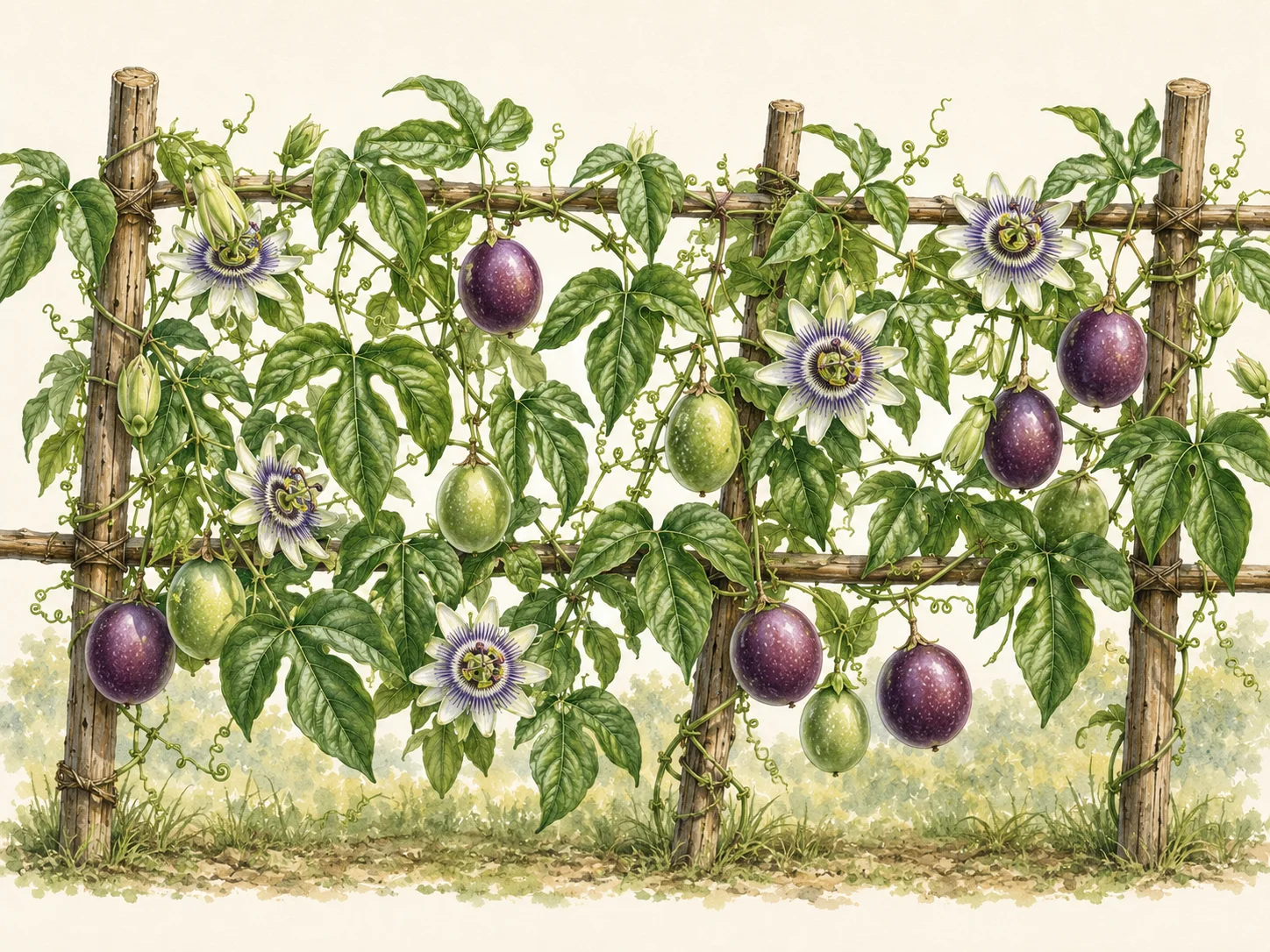
Botanical illustration of a passionfruit vine growing across a rustic trellis, with glossy lobed leaves, curling tendrils, purple-and-white passionflowers, and hanging green and ripe purple fruit.

Passionfruit (Trellised)

Passionfruit / Passion Fruit / Purple Granadilla

Passiflora edulis

Crop overview

Crop group
Fruit Vine
Lifecycle
Perennial
Growth habit
Fast-Growing Perennial Vine With Tendrils And Dense Evergreen Foliage

This profile covers edible passionfruit cultivars and forms of Passiflora edulis grown on a permanent trellis for fruit production. It includes purple passionfruit and yellow passionfruit, often listed as P. edulis f. flavicarpa, together with cultivated hybrids derived mainly from them. It does not cover banana passionfruit, giant granadilla, sweet granadilla, maypop or ornamental Passiflora species. These crops differ in climate, pollination, fruit and weed risk. Purple and yellow forms differ in cold tolerance, disease response and pollination. Purple passionfruit is often self-compatible, while yellow forms and some cultivars may require pollen from a compatible second vine. Cultivar-specific pollination guidance should take priority.

Variety examples

Frederick, Possum Purple, Panama Gold, Panama Red, Sweetheart

Quick facts

Plant spacing
2.40 m – 3.60 m
Row spacing
3 m
Support height
1.80 m – 2.40 m
Support strength
Heavy
Support types
Permanent Post-And-Wire Trellis, Heavy Welded-Wire Trellis, Strong Permanent Fence, Reinforced Arbor, Sturdy Pergola
Training method
Tendril
Vertical suitability
Recommended
Sun requirement
Full Sun
Days to harvest
180–365 days

Support & training

Training requirements

Install a strong permanent trellis, fence, arbor or post-and-wire system before planting. Train one or two main leaders upward to the support wire and loosely tie them until their tendrils attach. Once the leaders reach the top wire, guide selected lateral arms along the support. Allow fruiting shoots to hang or spread where flowers and fruit remain accessible. Keep vigorous shoots away from roofs, gutters, trees and lightweight fences. Check wires, posts and anchors regularly because a wet mature canopy and fruit crop can be very heavy.

Pruning requirements

Prune annually to remove dead, weak, tangled and unproductive growth, maintain airflow and stimulate new fruiting shoots. Passionfruit flowers and fruits on current-season growth. After the main harvest, shorten spent lateral shoots while retaining the permanent framework and healthy replacement growth. Remove vigorous unwanted shoots from below a graft union immediately. Avoid cutting the vine back to bare old wood unless renovation is necessary. Use clean tools and avoid pruning during prolonged wet weather where disease can enter wounds.

Growing setup guidance

Container

Minimum size: 50 L

Plants per container: 1

Grow one plant in a broad, stable container holding at least 50 L (about 13 US gal) of potting mix. A larger container is preferable for a vine retained for several years. Provide excellent drainage, consistent moisture, regular feeding and an independently anchored heavy trellis. Passionfruit has a shallow, moisture-sensitive root system and containers may dry quickly during hot or windy weather. Do not leave the potting mix waterlogged. Renew mulch and potting mix as needed, prune annually and plan to replace the vine when productivity declines or root disease develops.

Raised bed

Plant beside a permanent, strongly braced trellis. Raised beds are useful in heavy or wet soil because passionfruit is highly vulnerable to poor drainage and root disease. Provide fertile soil with consistent moisture and a generous organic mulch, while keeping mulch away from the stem base. Leave access on both sides of the trellis for pruning, pollination and harvesting fallen fruit. Allow one vine a substantial section of support so it does not smother neighbouring crops.

In-ground

Plant in fertile, moisture-retentive but freely draining soil beside a permanent support. Avoid low-lying, compacted or waterlogged sites. Mulch the shallow root zone to conserve moisture and suppress weeds, but keep mulch clear of the stem. Water consistently during flowering and fruit development without saturating the roots. Allow enough space for a vigorous canopy and regular pruning. In climates where passionfruit naturalises, remove unwanted seedlings and fruit outside the intended area.

Planting, pollination & harvest

Sowing / transplanting

Use a healthy named cultivar, cutting-grown plant or grafted plant where predictable fruit quality and pollination behaviour are important. Seed-grown vines vary and may not reproduce the parent fruit exactly. Fresh seed can be sown after removing and washing away the pulp. Soaking may speed germination, which commonly takes several weeks. Cuttings, layering and grafting are also used. Plant after frost danger has passed when soil and nights are warm. Set the vine at the same depth it grew in its container, keep any graft union above soil level and install the permanent trellis before rapid growth begins.

Pollination

Passionfruit flowers attract bees, especially large bees capable of contacting both anthers and stigmas. Good insect activity is important for full fruit set and well-filled fruit. Pollination requirements vary. Many purple Passiflora edulis cultivars are self-compatible, while yellow passionfruit and some hybrids are self-incompatible and require pollen from a compatible second vine. Do not assume that every named cultivar will fruit alone. Hand pollination can improve set where compatible pollen is available but pollinator activity is low. Transfer fresh pollen between newly opened compatible flowers during the period when stigmas are receptive.

Warnings

Passionfruit is frost-tender. Cold can damage flowers, fruit and vines, while severe frost may kill the plant. Purple forms are generally more cold-tolerant than yellow forms. The vine grows rapidly and can overwhelm lightweight supports, roofs, gutters, trees and nearby plants. Use a permanent heavy trellis and prune regularly. Excellent drainage is essential. Watch for Phytophthora and other root or collar rots, Fusarium wilt, viruses, anthracnose, alternaria, scab, fruit rots, fruit flies, scale insects, mealybugs, aphids, mites and nematodes. Grafted plants may produce vigorous shoots from the rootstock below the graft. Remove these promptly so they do not replace the fruiting cultivar. Some Passiflora species are invasive or regulated in particular regions. Confirm the plant is Passiflora edulis and manage dropped fruit and seedlings where escape is a concern. Do not eat damaged, mouldy or fermented fruit.

General notes

A newly planted vine may flower and crop within about 6–12 months under favourable conditions, while fruit commonly ripens about 7–11 weeks after pollination. Harvest when fruit has developed its full cultivar colour and detaches easily or falls naturally. Collect fallen fruit frequently to prevent sun damage, rot and pest attack. The rind often wrinkles after harvest as water is lost; wrinkling is not required before eating. Cut the fruit and scoop out the aromatic pulp and edible seeds. Maintain consistent water and balanced nutrition. Excessive nitrogen can produce a large leafy vine with delayed or reduced flowering. Productive life varies with climate, disease and cultivar. Home vines are often replaced after several years when yield or health declines.

Climate guidance

Climate suitability: Specialist

Planting season

Plant after frost danger has passed only where the vine can be protected or overwintered. Container culture under frost-free protection is more reliable than permanent outdoor planting.

Wet / dry season

Water consistently through summer flowering and fruit development, then reduce irrigation during protected winter dormancy or slow growth.

Soil temperature

Wait for warm soil and mild nights. Cold spring soil slows root growth and may cause chlorosis.

Frost sensitivity

Very frost-tender. Purple cultivars tolerate slightly more cold than yellow forms, but severe frost can kill any Passiflora edulis vine.

Heat sensitivity

Warm summers support growth, but extreme inland heat, hot dry winds and drought can cause flower drop, sunburn and poor fruit fill.

Humidity / disease

Hot rainy periods can increase root rot, anthracnose and fruit disease. Winter protection can encourage scale, mites and aphids.

Sowing guidance

Plant a named vine after frost or maintain it permanently in a large movable container. Install the permanent summer support before growth accelerates.

Notes

Fruit production is experimental unless the vine survives winter under protection. Allow enough warm time for fruit to ripen roughly two to three months after flowering.

Ready to plan?

Open the planner with Passionfruit (Trellised) preselected.