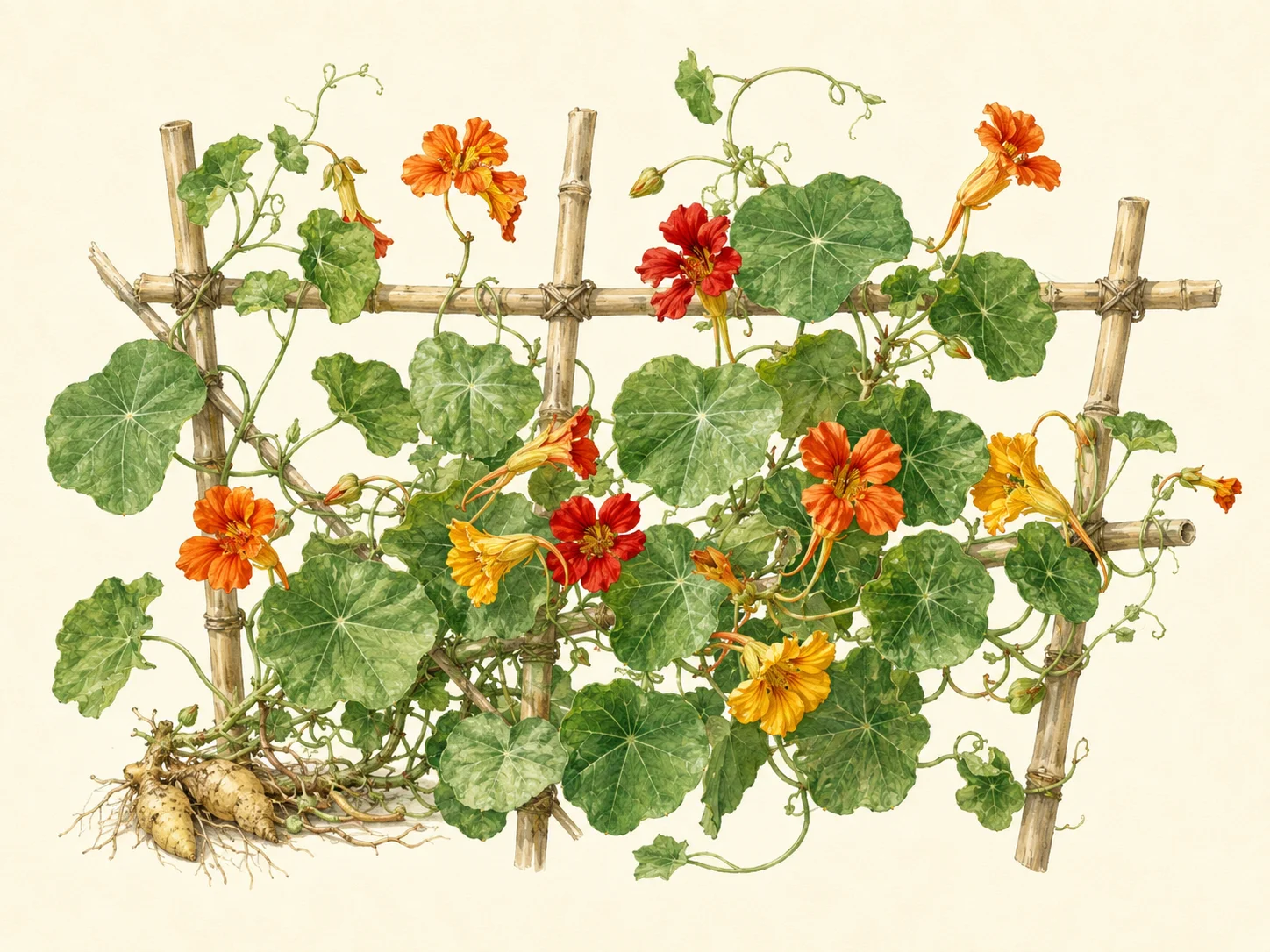
Mashua / Tuberous Nasturtium
Mashua / Tuberous Nasturtium / Añu
Tropaeolum tuberosum
Crop overview
- Crop group
- Tuberous Edible Climber
- Lifecycle
- Perennial
- Growth habit
- Tuber-Forming Herbaceous Climber With Twining Or Scrambling Stems And Lobed Leaves, Usually Grown As A Seasonal Food Crop
Covers edible mashua grown for tubers. It is an Andean species adapted to cool high-elevation conditions and is distinct from common garden nasturtium.
Variety examples
Yellow mashua, Purple mashua, Red-striped mashua
Quick facts
- Plant spacing
- 40 cm – 60 cm
- Row spacing
- 90 cm
- Support height
- 1.80 m – 3 m
- Support strength
- Medium
- Support types
- Trellis Netting, Bamboo Trellis, Wire Fence, Garden Arch
- Training method
- Twining
- Vertical suitability
- Recommended
- Sun requirement
- Full Sun
- Days to harvest
- 180–270 days
Support & training
Training requirements
Guide young stems onto a trellis or fence and keep them off neighbouring crops.
Pruning requirements
Usually little pruning is needed beyond removing damaged growth and keeping vines within their support.
Growing setup guidance
Container
Minimum size: 40 L
Plants per container: 1
Use a large, deep container with fertile, moisture-retentive but well-drained mix and a tall support. Container-grown plants need reliable watering.
Raised bed
A deep raised bed suits the tubers and makes harvest easier. Provide a trellis before vines elongate.
In-ground
Grow in fertile, moist but well-drained soil with a support. Cooler sites suit it better than hot exposed beds.
Planting, pollination & harvest
Sowing / transplanting
Plant healthy tubers in spring after the worst frost risk. In very mild climates, planting can be timed so tuber development occurs during shortening days and cool weather.
Pollination
Pollination is not required for tuber production.
Warnings
Tuber formation can be strongly influenced by day length and temperature, so performance varies greatly outside its Andean climate. Do not confuse mashua with ordinary climbing nasturtium.
General notes
Kew records mashua as an Andean climbing food plant associated with high elevations, while RHS describes Tropaeolum tuberosum forms as tuberous herbaceous climbers reaching several metres.
Climate guidance
Climate suitability: Possible
Planting season
Plant in spring after frost danger
Northern hemisphere months
Mar-May
Southern hemisphere months
Sep-Nov
Wet / dry season
Maintain moisture through summer but avoid saturated soil.
Soil temperature
Plant once soil is workable.
Frost sensitivity
Hard frost kills the top growth.
Heat sensitivity
Prolonged high summer heat can suppress growth.
Humidity / disease
Mulch roots and keep vines ventilated.
Sowing guidance
Choose the coolest practical garden position in very hot inland areas.
Notes
Better where nights cool down and autumn arrives gradually.