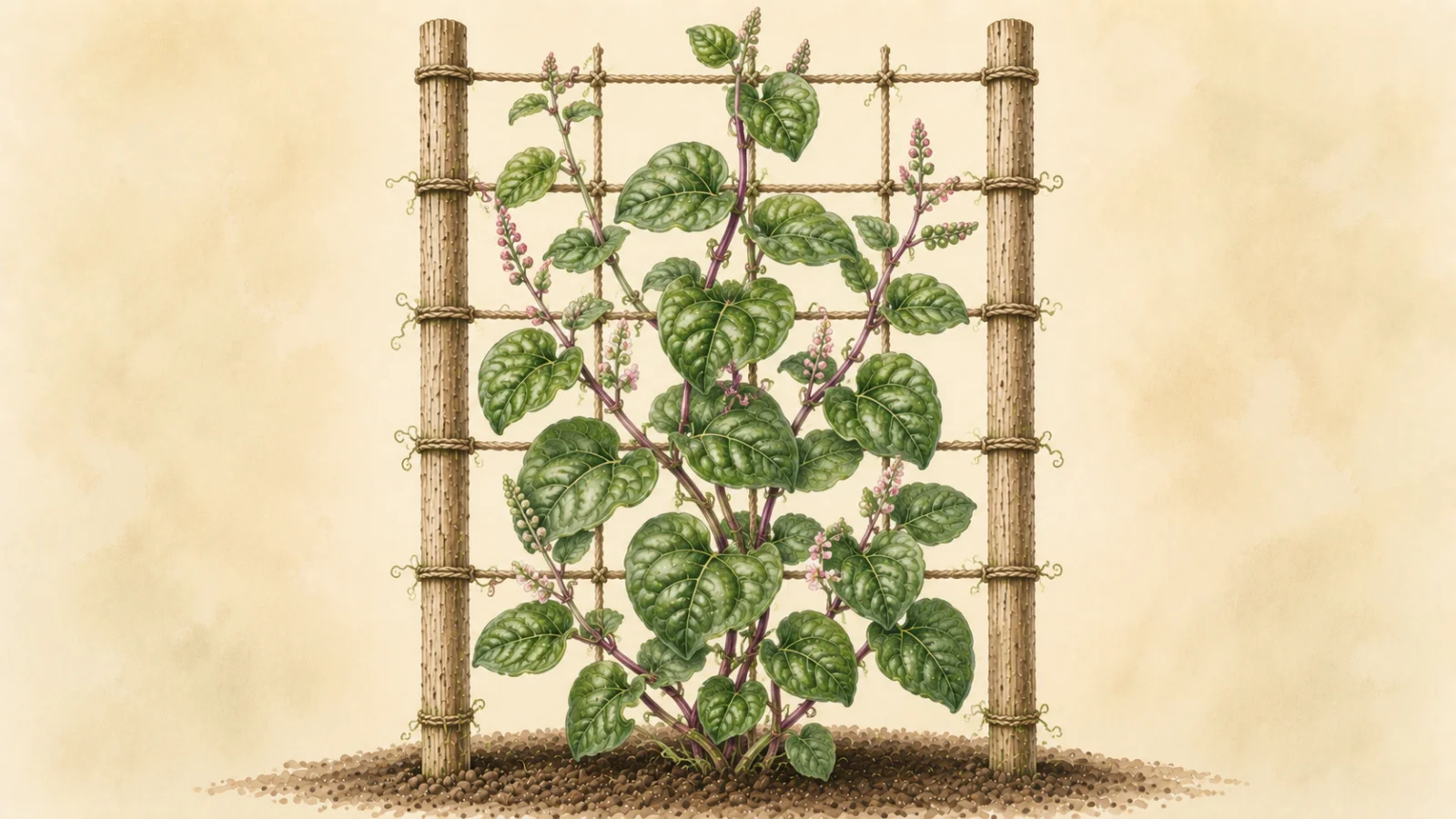
Botanical watercolor illustration of Malabar spinach (Basella alba) growing vertically on a rustic wooden trellis, with glossy heart-shaped green leaves, purple stems, delicate pink flower spikes, and climbing vines against a soft cream background.

Malabar Spinach

Malabar Spinach / Vine Spinach

Basella alba

Crop overview

Crop group
Leafy Green
Lifecycle
Perennial
Growth habit
Fast-Growing Twining Vine With Succulent Edible Leaves And Stems

This profile covers edible Malabar spinach grown vertically for its leaves and tender shoot tips. It includes green-stemmed Basella alba and red-stemmed forms commonly sold as Basella rubra, Red Malabar or Rubra. Malabar spinach is not true spinach. It does not cover New Zealand spinach, Okinawa spinach, longevity spinach, water spinach or ordinary cool-season spinach.

Variety examples

Green Malabar, Green Stem, Red Malabar, Red Stem, Rubra

Quick facts

Plant spacing
30 cm – 45 cm
Row spacing
90 cm
Support height
1.80 m – 2.40 m
Support strength
Medium
Support types
Sturdy Trellis, Wire Fence, Trellis Netting, Garden Arch, String Trellis, Stakes With Horizontal Wire
Training method
Twining
Vertical suitability
Recommended
Sun requirement
Partial Shade
Days to harvest
60–85 days

Support & training

Training requirements

Install the support before planting. Guide young shoots toward the trellis and loosely tie them where necessary until they begin twining around the support. Redirect long shoots through open sections of the trellis as they grow. The vine does not use tendrils, so it needs narrow supports, netting, wire or string that its stems can wind around.

Pruning requirements

Harvest leaves and tender shoot tips regularly to encourage branching and keep the vine manageable. Pinch or shorten overly long shoots where denser growth is wanted. Remove damaged or diseased foliage as needed. Flower spikes may be removed if leaf production is the priority, although some can be left to produce seed.

Growing setup guidance

Container

Minimum size: 30 L

Plants per container: 1

Grow one plant in a stable container holding at least 30 L (about 8 US gal) of potting mix. Larger containers are preferable where the growing season is long or conditions are hot, dry or windy. Provide a firmly anchored trellis and keep the potting mix consistently moist but never waterlogged. Regular harvesting will help keep the vine within a manageable size. Feed periodically because repeated leaf harvest removes nutrients.

Raised bed

Plant beside an installed trellis and provide fertile, moisture-retentive but freely draining soil. Train and harvest the vine regularly so it does not overwhelm neighbouring crops. Position the support where the vigorous summer growth will not heavily shade shorter plants unless that shade is intentional.

In-ground

Plant in fertile soil enriched with organic matter beside a sturdy trellis or fence. Maintain consistent moisture during hot weather but avoid saturated ground. Stems may form roots where they remain in contact with moist soil. Redirect or prune spreading stems if you do not want the plant to extend beyond its allocated space.

Planting, pollination & harvest

Sowing / transplanting

Sow or transplant only after frost danger has passed, the soil has warmed to at least about 18°C (65°F), and nights are consistently mild. Seeds have a hard coat and may take 10 days to 3 weeks to germinate. Soaking them overnight or lightly scarifying the seed coat can speed germination. In short-season climates, start seeds indoors about 6–8 weeks before the intended planting date. Harden seedlings gradually before transplanting. In warm climates, direct sow into warm soil or propagate plants from tender stem cuttings.

Pollination

Pollination is not required for leaf and shoot production. The plant may eventually produce small white or pink flowers followed by dark purple or black berries. Allow mature berries to develop where seed saving is wanted, or remove flower spikes where continued leafy growth is the priority.

Warnings

Malabar spinach is extremely sensitive to frost and grows slowly in cool conditions. It may produce little growth while nights remain below about 16°C (60°F). Keep the soil consistently moist but not waterlogged. Dry conditions may encourage flowering and can make the leaves less tender or more bitter. The vigorous vines may root where stems touch moist soil and can self-seed in warm climates. Remove unwanted seedlings and ripe berries where spreading is a concern. The purple-black berries can stain skin, clothing and hard surfaces. Watch for occasional leaf spots, chewing insects and sap-feeding pests, particularly in warm, wet weather.

General notes

Harvest young leaves and tender shoot tips regularly. Frequent harvesting encourages branching and continued leafy growth. Young leaves and shoots may be eaten raw or cooked. Older leaves and stems are generally better cooked. The leaves have a succulent, slightly mucilaginous texture that can help thicken soups, stews and sauces. Malabar spinach is a heat-loving spinach substitute rather than a botanical relative of ordinary spinach. Production normally improves as summer conditions become genuinely warm.

Climate guidance

Planting season

Plant in late spring after frost danger has passed, the soil has warmed and nights are reliably mild. The crop may begin slowly but should grow rapidly during the hot part of summer.

Wet / dry season

Water deeply and consistently during dry weather. Mulch after the soil has warmed to reduce moisture fluctuations, but do not keep the root zone waterlogged.

Soil temperature

Plant when soil is at least about 18°C (65°F). Avoid transplanting into cold, wet spring soil because cool conditions greatly delay establishment.

Frost sensitivity

Extremely frost-tender. Treat it as an annual and harvest remaining leaves and tender shoots before the first autumn frost.

Heat sensitivity

Hot summers suit Malabar spinach extremely well. It can remain productive during temperatures in the 30s°C (90s°F), provided the soil stays moist. Severe heat combined with dry soil can encourage flowering and reduce leaf quality.

Humidity / disease

Warm summer humidity is generally well tolerated. Maintain airflow through regular harvesting and avoid allowing dense growth to remain continually wet.

Sowing guidance

Start seeds indoors 6–8 weeks before planting out, or direct sow once the soil and nights are thoroughly warm. Soaking or scarifying the seed can speed germination.

Notes

This climate can produce exceptionally vigorous summer growth despite the plant being unable to survive winter outdoors. Keep tying, redirecting and harvesting the vines as they lengthen.

Ready to plan?

Open the planner with Malabar Spinach preselected.