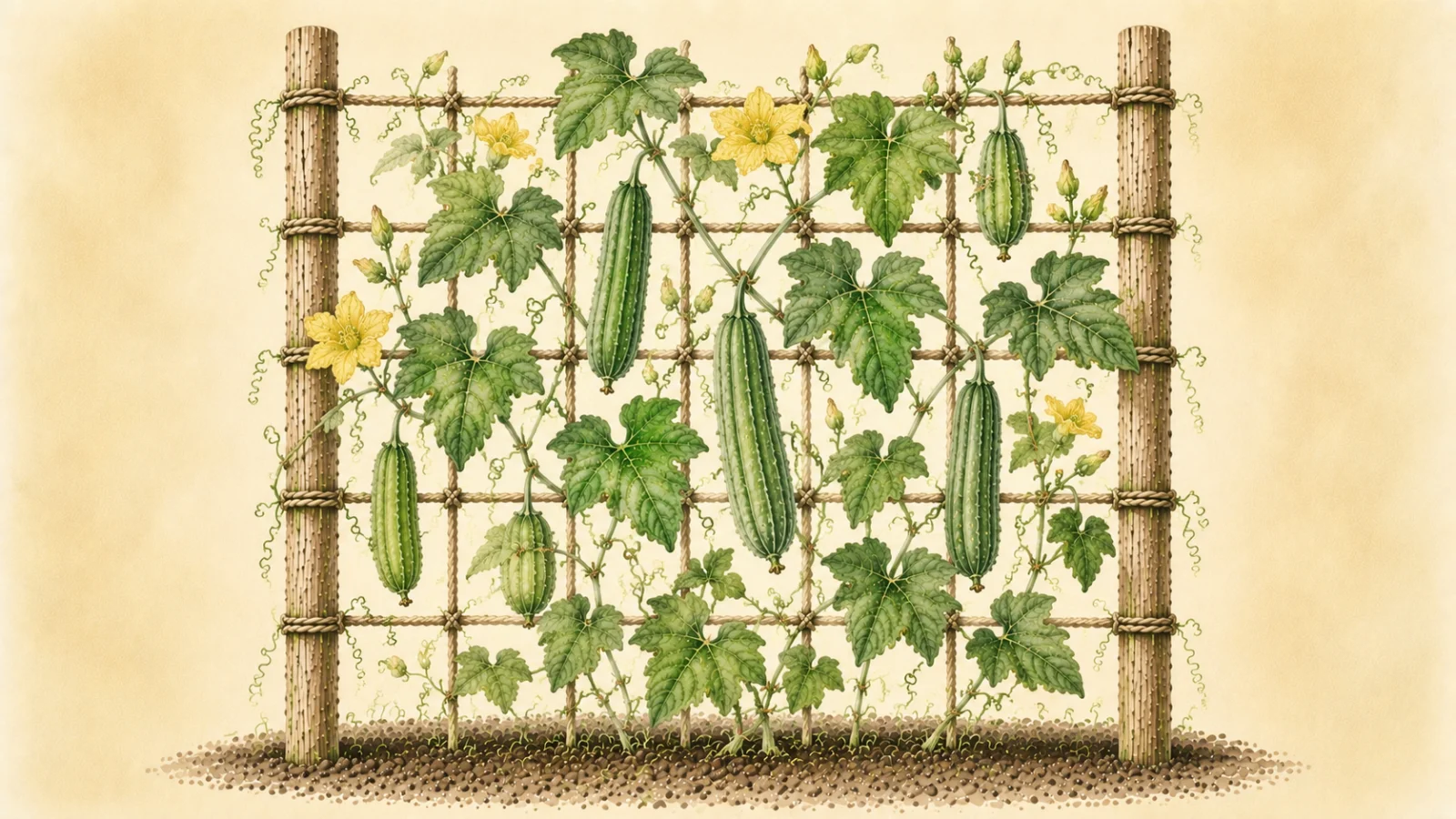
Botanical watercolor illustration of a luffa vine (Luffa aegyptiaca) growing vertically on a rustic wooden trellis, with large lobed green leaves, yellow flowers, curling tendrils, and multiple ridged luffa gourds in different stages of development against a soft cream background.

Luffa / Loofah (Trellised)

Luffa / Loofah / Sponge Gourd

Luffa spp.

Crop overview

Crop group
Cucurbit
Lifecycle
Annual
Growth habit
Extremely Vigorous Long-Season Climbing Vine With Branched Tendrils

This profile covers smooth luffa and angled or ridged luffa grown vertically. Young tender fruit may be harvested as a vegetable, while fully mature dry fruit may be processed into natural sponges. It includes Luffa aegyptiaca, which is also widely listed under the synonym Luffa cylindrica, and Luffa acutangula. It does not cover ball luffa, Luffa operculata, bottle gourds, snake gourds or other ornamental and hard-shelled gourds. Only young, tender luffa fruit is used as a vegetable; fully mature fibrous fruit is not edible.

Variety examples

Smooth Boy, Smooth Beauty, South Winner, Lucky Boy, Hybrid Green Glory, Summer Long, Hybrid Asian Pride

Quick facts

Plant spacing
60 cm – 90 cm
Row spacing
1.80 m
Support height
1.80 m – 2.40 m
Support strength
Extra Heavy
Support types
Cattle-Panel Trellis, Reinforced Pergola, Heavy Welded-Wire Trellis, Sturdy Overhead-Wire Trellis, Reinforced Garden Arch
Training method
Tendril
Vertical suitability
Recommended
Sun requirement
Full Sun
Days to harvest
60–180 days

Support & training

Training requirements

Install and firmly brace the support before sowing or transplanting. Guide young vines toward the trellis and loosely secure them until their branched tendrils attach. Spread the highly vigorous growth across the available support rather than allowing the vine to collect in one dense section. Allow long fruit to hang freely so it develops straight and does not become trapped or bent within trellis mesh.

Pruning requirements

Pruning is optional. Redirect excessive growth and remove damaged, diseased or severely crowded vines where necessary for access and airflow. A managed plant may be trained to one main leader with selected lateral shoots, but avoid removing side growth indiscriminately because female flowers and fruit commonly develop on lateral vines. Where mature sponges are the goal in a short season, late flowers and very small fruit may be removed toward the end of the growing period so the plant can direct its remaining energy into fruit that is already well developed.

Growing setup guidance

Container

Minimum size: 50 L

Plants per container: 1

Grow one plant in a broad, stable container holding at least 50 L (about 13 US gal) of potting mix. A larger container is strongly preferable where the goal is full-season sponge production or where the growing season is long. Provide excellent drainage, abundant moisture, regular feeding and an independently anchored extra-heavy support. The mature vine can become extremely large, dense and wind-catching. Check moisture frequently during flowering and fruit enlargement without allowing the container to remain waterlogged.

Raised bed

Plant beside a completed and strongly braced trellis. Raised beds can provide useful drainage in rainy climates but must contain enough soil volume to support an exceptionally vigorous vine. Leave clear access for guiding vines, checking pollination, harvesting tender fruit and removing mature sponge fruit. Position the trellis where the dense canopy will not overwhelm or heavily shade smaller crops.

In-ground

Plant in warm, fertile, moisture-retentive but freely draining soil beside a completed extra-heavy support. Maintain consistent moisture without saturating the root zone. Allow considerable overhead and lateral space because vines may extend well beyond their original planting position. Redirect vines regularly rather than allowing them to climb trees, buildings or neighbouring crops.

Planting, pollination & harvest

Sowing / transplanting

Direct sow after all frost danger has passed and the soil is thoroughly warm, preferably at least about 18°C (65°F). Where the growing season is limited, start seedlings indoors about 4–6 weeks before the intended planting date. Sow in individual containers, provide warmth and strong light, and transplant carefully after hardening when seedlings have two or three true leaves. Install the trellis before sowing or transplanting. Luffa requires a long, hot growing season, particularly when the goal is fully mature dry sponges.

Pollination

Luffa plants produce separate male and female flowers on the same vine. Bees and other insects normally transfer pollen between them. The first flowers are often male and naturally fall without forming fruit. Female flowers have a small immature fruit behind the petals. Where female flowers open but young fruit repeatedly yellows or aborts, hand pollination may improve fruit set. Transfer fresh pollen from a newly opened male flower to the centre of a newly opened female flower during the morning.

Warnings

Luffa is very frost-tender and may fail to produce mature sponges in a short or cool growing season. The vines can overwhelm lightweight structures, neighbouring plants and nearby trees. Use a firmly braced support and check it regularly as the canopy and fruit become heavier. Watch for leafminers, aphids, mites, cucumber beetles, caterpillars, powdery mildew, downy mildew, anthracnose, bacterial diseases, root disease and fruit rot. Fruit intended as a vegetable becomes fibrous and tough as it matures. Harvest it young. Do not eat luffa fruit with a distinctly strong or unpleasant bitter taste; spit it out and discard the fruit. Long fruit may become wedged or bent within trellis openings. Check developing fruit frequently and redirect it while still small.

General notes

For vegetable use, harvest smooth or angled luffa while the fruit is young, tender and easily cut. Many cultivars are harvested at approximately 10–15 cm long, but the suitable size varies, particularly among long Asian angled-luffa cultivars. Tender texture is a better guide than maximum length. For sponge production, leave selected fruit on the vine until it is fully mature. The fruit should become lightweight, and the skin should turn yellow, tan or brown and begin separating from the internal fibre network. Mature seeds may rattle inside. Cut mature fruit from the vine rather than pulling it. Peel away the skin, remove the seeds, wash the fibrous interior and dry it thoroughly before storage or use. Soaking the fruit can help loosen a rind that is difficult to peel. A long, warm and preferably dry ripening period produces the most dependable sponges. Prolonged wet weather during final maturation may cause fruit to rot before it dries.

Climate guidance

Climate suitability: Recommended

Planting season

Plant in late spring after frost danger has passed and establish the crop early enough to use the full hot summer. Starting with transplants can provide valuable extra growing time.

Wet / dry season

Water deeply and consistently during dry periods, especially through flowering and fruit enlargement. Ensure rapid drainage after summer storms.

Soil temperature

Plant into soil at least about 18°C (65°F). Avoid setting plants into cold spring ground merely because daytime air temperatures are warm.

Frost sensitivity

Very frost-tender. Harvest tender fruit and any mature or nearly mature sponge fruit before autumn frost.

Heat sensitivity

Hot summers generally suit luffa well. Extreme heat combined with dry soil may cause flower or young-fruit abortion, so maintain consistent moisture.

Humidity / disease

Hot, rainy periods can increase mildew, leafminer, leaf-spot, fruit-rot and root-disease pressure. Train the vine openly and avoid waterlogging.

Sowing guidance

Start seedlings indoors about 4–6 weeks before planting out, or direct sow into thoroughly warm soil where the hot season is long. Install the support before planting.

Notes

Immature edible luffa is easier to produce than mature sponges where autumn arrives quickly. Keep the earliest healthy fruit for sponges and harvest later fruit young.

Ready to plan?

Open the planner with Luffa / Loofah (Trellised) preselected.