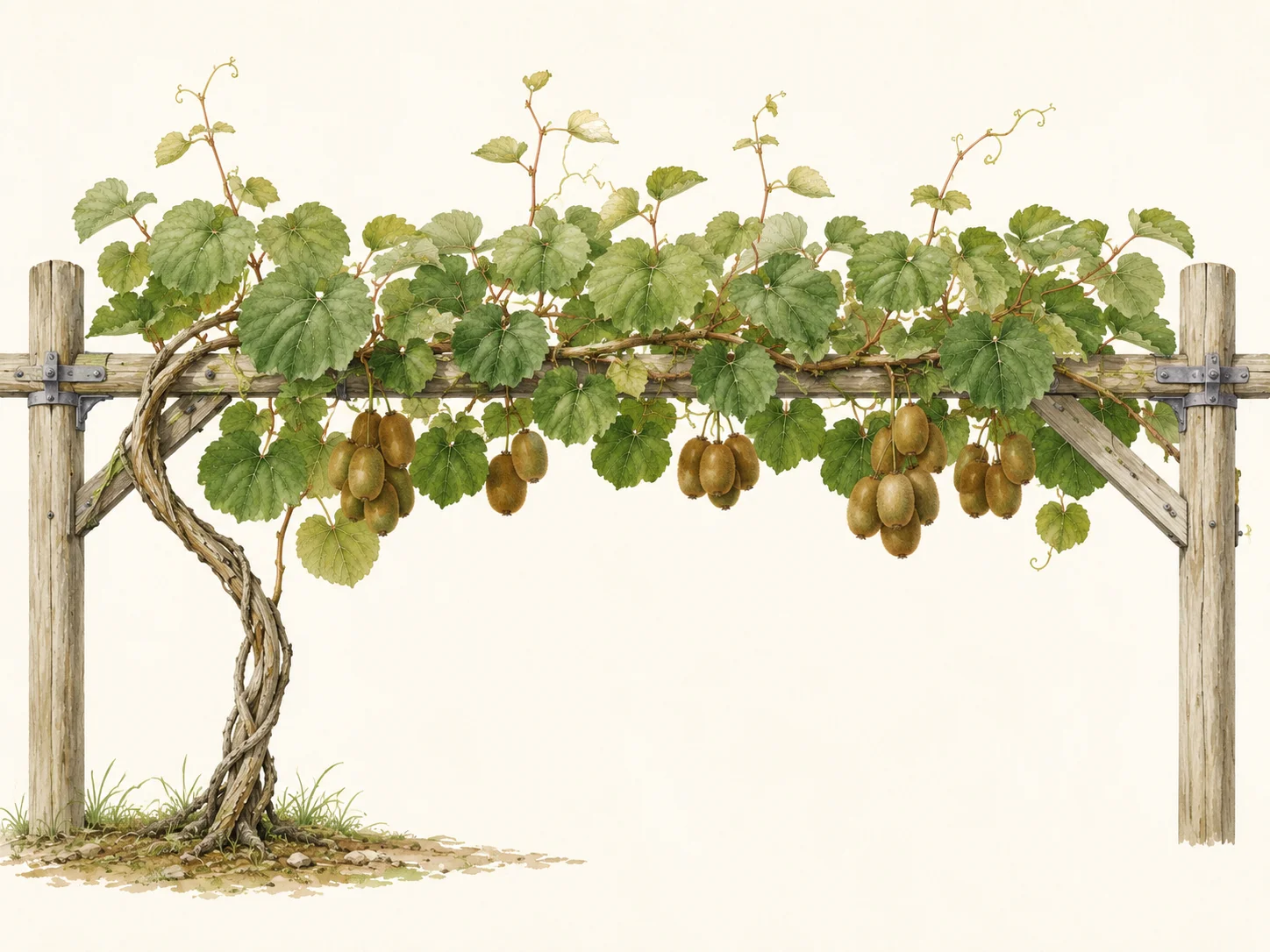
Kiwifruit
Kiwifruit / Fuzzy Kiwi
Actinidia chinensis var. deliciosa
Crop overview
- Crop group
- Perennial Fruit Vine
- Lifecycle
- Perennial
- Growth habit
- Very Vigorous, Long-Lived Deciduous Twining Vine With A Heavy Permanent Framework And Crop Load
Covers fuzzy green and gold kiwifruit grown on a permanent T-bar, pergola or arbor. Hardy kiwiberry has a separate profile.
Variety examples
Hayward, Bruno, Gold kiwifruit, Self-fertile cultivars
Quick facts
- Plant spacing
- 4.50 m – 5.50 m
- Row spacing
- 4.50 m
- Support height
- 1.80 m – 2.15 m
- Support strength
- Extra Heavy
- Support types
- Heavy T-Bar Trellis, Reinforced Pergola, Strong Arbor, Permanent Overhead Wire System
- Training method
- Twining
- Vertical suitability
- Recommended
- Sun requirement
- Full Sun
Support & training
Training requirements
Train one trunk to the trellis, then form permanent cordons and regularly spaced fruiting laterals. Prevent vines from wrapping tightly around structural posts.
Pruning requirements
Requires substantial winter pruning and repeated summer pruning to control vigorous growth, renew fruiting wood and maintain light through the canopy.
Growing setup guidance
Container
Not recommended for ordinary containers because the vine is vigorous, long-lived and carries a very heavy canopy and crop.
Raised bed
Only suitable for a very large permanent bed with deep soil and a heavily braced support. Do not treat it like an annual trellis crop.
In-ground
Plant in deep, well-drained soil beside a permanent support. Protect shallow roots from cultivation and drought, and leave room to reach the whole canopy for pruning.
Planting, pollination & harvest
Sowing / transplanting
Plant nursery vines after severe frost risk has passed or while dormant where locally recommended. Confirm chill requirements and polliniser compatibility before purchase.
Pollination
Most cultivars are dioecious: plant a compatible male that flowers at the same time as the female, unless using a proven self-fertile cultivar. Insect pollination remains important.
Warnings
Mature vines are extremely heavy and can collapse weak structures. Late spring frost, waterlogged soil, drought and wind can damage vines and crops.
General notes
Allow about 4.5 m of trellis per plant in a typical home-garden system. Fruit production may take several years while the permanent framework is established.
Climate guidance
Climate suitability: Possible
Planting season
Plant while dormant or in early spring
Northern hemisphere months
Mar-Apr
Southern hemisphere months
Sep-Oct
Wet / dry season
Irrigate consistently during hot, dry weather
Soil temperature
Plant before rapid spring shoot growth
Frost sensitivity
New shoots and flowers are highly vulnerable to spring frost
Heat sensitivity
Hot, dry winds can scorch leaves and fruit
Humidity / disease
Keep the canopy open
Sowing guidance
Select a cultivar matched to winter minimums and season length
Notes
Good winter chill can help, but heat, wind and late frost need management.