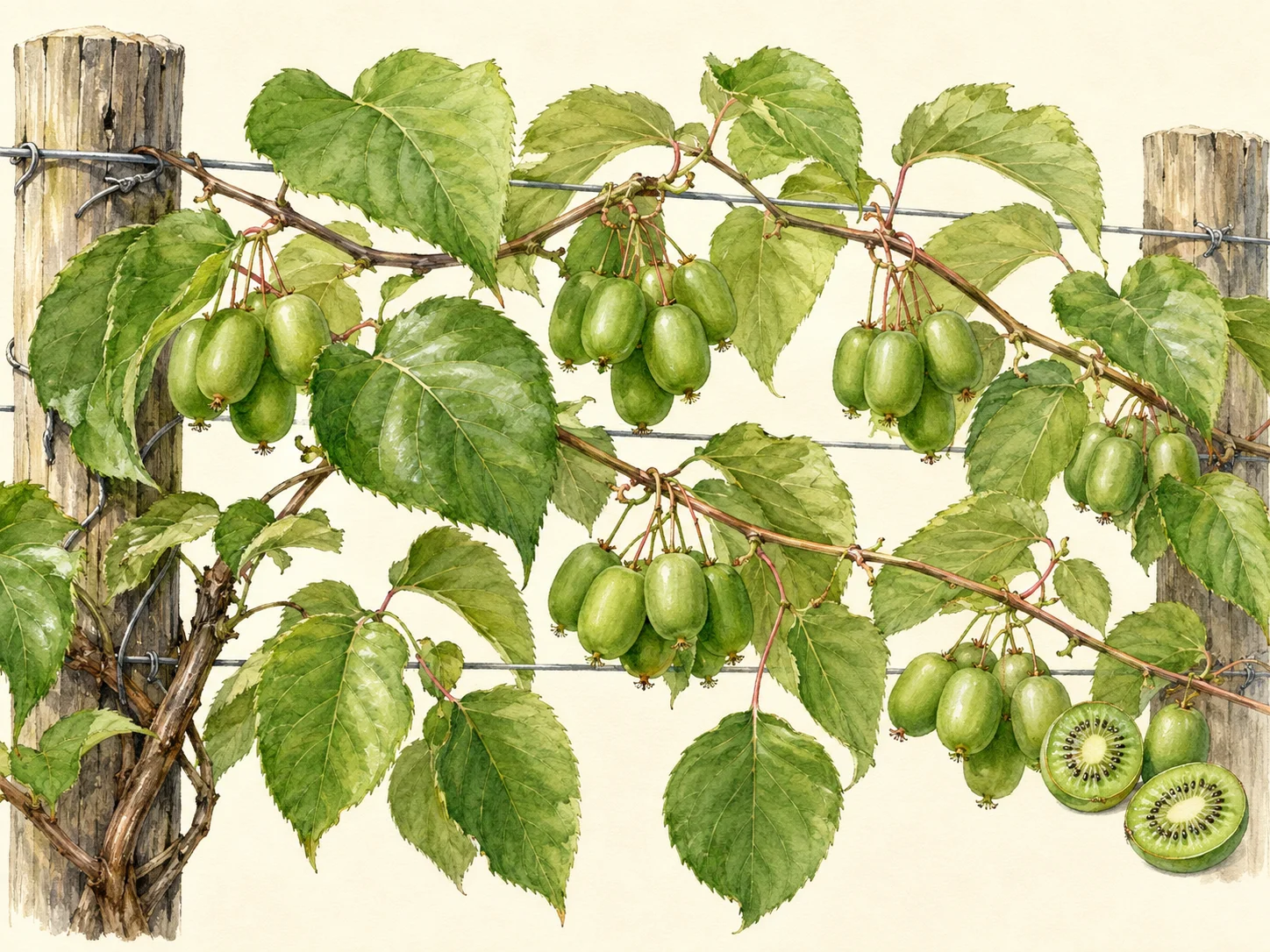
Kiwiberry / Hardy Kiwi
Actinidia arguta and Actinidia kolomikta
Crop overview
- Crop group
- Perennial Fruit Vine
- Lifecycle
- Perennial
- Growth habit
- Very Vigorous, Cold-Hardy Deciduous Twining Vine Producing Small Smooth-Skinned Kiwi Fruit
Covers hardy kiwiberries, mainly Actinidia arguta and A. kolomikta. These are distinct from standard fuzzy kiwifruit.
Variety examples
Anna (Ananasnaya), Geneva, Issai, Ken's Red, Arctic Beauty types
Quick facts
- Plant spacing
- 3 m – 4.50 m
- Row spacing
- 4.50 m
- Support height
- 1.80 m – 2.15 m
- Support strength
- Extra Heavy
- Support types
- Heavy T-Bar Trellis, Reinforced Pergola, Strong Arbor, Permanent Wire Trellis
- Training method
- Twining
- Vertical suitability
- Recommended
- Sun requirement
- Full Sun
Support & training
Training requirements
Train a single trunk to a T-bar or arbor, then form permanent cordons and evenly spaced fruiting laterals. Prevent uncontrolled wrapping around posts.
Pruning requirements
Requires annual dormant pruning plus summer pruning to control long exploratory shoots and keep the canopy reachable and productive.
Growing setup guidance
Container
Not recommended for ordinary containers because mature vines are vigorous, long-lived and heavy.
Raised bed
Only suitable for a large, deep, permanent bed with a strong trellis and room for vigorous perennial roots.
In-ground
Plant beside a permanent support in moisture-retentive but well-drained soil. Protect roots from drought and leave access for regular pruning and harvest.
Planting, pollination & harvest
Sowing / transplanting
Plant nursery vines in spring after severe frost risk passes. Choose species and cultivar for local winter temperatures, season length and pollination needs.
Pollination
Most cultivars need a compatible male vine flowering at the same time. Some sold as self-fertile may crop alone but often produce better with a polliniser.
Warnings
A mature vine becomes very heavy and can overwhelm small garden trellises. Spring growth is vulnerable to frost even when dormant vines are extremely cold hardy.
General notes
Fruit is eaten whole without peeling. Vines commonly take several years to train before useful production.
Climate guidance
Climate suitability: Recommended
Planting season
Plant while dormant or in early spring
Northern hemisphere months
Mar-Apr
Southern hemisphere months
Sep-Oct
Wet / dry season
Mulch and irrigate during hot dry periods
Soil temperature
Plant before vigorous spring growth begins
Frost sensitivity
Late frost is the main risk to spring growth
Heat sensitivity
Some species and cultivars need protection from severe summer heat
Humidity / disease
Summer pruning improves airflow
Sowing guidance
Match the species to local winter lows and summer heat
Notes
Generally well suited where spring frosts can be managed.