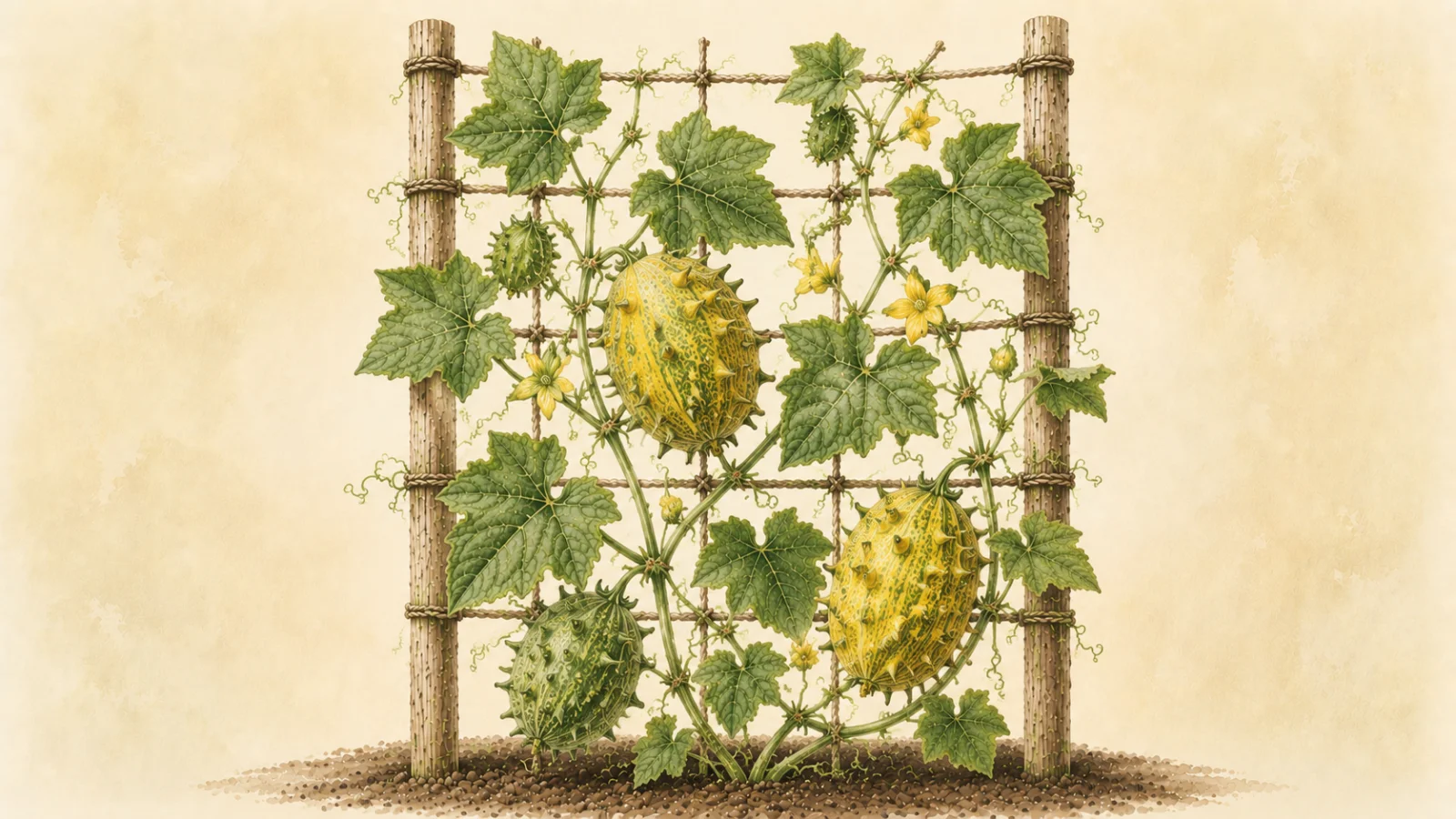
Botanical watercolor illustration of kiwano (Cucumis metuliferus) climbing a rustic wooden trellis, with lobed green leaves, curling tendrils, yellow flowers, and horned fruits at green immature and golden-orange ripe stages against a soft cream background.

Kiwano / African Horned Cucumber

Kiwano / African Horned Cucumber / Jelly Melon

Cucumis metuliferus

Crop overview

Crop group
Cucurbit
Lifecycle
Annual
Growth habit
Vigorous Prickly Climbing Or Sprawling Vine With Tendrils

This profile covers Cucumis metuliferus grown vertically for its ripe edible fruit, commonly called kiwano, African horned cucumber, horned melon or jelly melon. The fruit is normally harvested when the skin changes from green to yellow-orange or orange and the interior contains green, jelly-like flesh and edible seeds. It does not cover ordinary cucumbers, African wild Cucumis species, pepino melon or bitter melon. Kiwano is an annual crop.

Quick facts

Plant spacing
90 cm – 1.20 m
Row spacing
1.50 m
Support height
1.50 m – 2.10 m
Support strength
Medium
Support types
Wire Trellis, Heavy Trellis Netting, Sturdy Fence, Reinforced Garden Arch, A-Frame Trellis
Training method
Tendril
Vertical suitability
Recommended
Sun requirement
Full Sun
Days to harvest
100–120 days

Support & training

Training requirements

Install a sturdy wire, mesh or net support before sowing or transplanting. Guide young shoots toward the trellis until the tendrils attach. Spread the branching vine across open sections of the support and keep developing fruit from becoming trapped in narrow mesh. Wear gloves if the bristly stems and spines irritate the skin.

Pruning requirements

Pruning is optional. Redirect or shorten excessive shoots and remove damaged, diseased or severely congested growth where necessary. Avoid heavy pruning because fruit develops on continuing lateral growth. In a short season, removing very late flowers and tiny fruit may help earlier fruit finish ripening.

Growing setup guidance

Container

Minimum size: 40 L

Plants per container: 1

Grow one plant in a broad, stable container holding at least 40 L (about 10 US gal) of potting mix. Larger containers provide more stable moisture in hot or windy weather. Provide a firmly anchored medium-strength trellis, consistent moisture and excellent drainage. The stems and fruit are prickly, so leave enough room to train and harvest without brushing against the plant repeatedly.

Raised bed

Plant beside an installed trellis or arch. Raised beds can improve drainage in wet climates and keep the prickly fruit away from paths and soil. Allow enough room for the branching vine and maintain access for pollination checks and harvest. Redirect shoots before they smother neighbouring crops.

In-ground

Plant in warm, fertile, freely draining soil beside a sturdy support. Maintain even moisture during flowering and fruit enlargement, while avoiding saturated ground. Allow substantial room because the vine may sprawl or climb vigorously and can smother smaller plants if left unmanaged.

Planting, pollination & harvest

Sowing / transplanting

Direct sow after frost danger has passed when soil and nights are thoroughly warm. For an earlier crop, start seed in individual containers about 3–4 weeks before planting out. Harden seedlings gradually and transplant carefully after the soil has warmed to at least about 18°C (65°F). Install the trellis before planting. Kiwano needs a long warm season to reach fully orange ripe fruit.

Pollination

Kiwano produces separate male and female flowers on the same plant and is self-fertile, but insects are needed to transfer pollen reliably. Bees and other pollinators visit the yellow flowers. Avoid applying insecticides while flowers are open. Hand pollination may help where female flowers repeatedly fail to develop fruit.

Warnings

Kiwano is extremely frost-tender and requires a long warm season to ripen fully. The stems, leaves and fruit have stiff hairs or spines that can scratch skin. Wear gloves when training vines or harvesting. The vine can spread vigorously and may self-seed in warm climates. Remove fallen fruit and unwanted seedlings where spreading is a concern. Watch for aphids, mites, whiteflies, cucumber beetles, caterpillars, powdery mildew, downy mildew, leaf spots, root rots and cucurbit viruses.

General notes

Harvest ripe fruit when the skin has changed from green to yellow-orange or orange. The fruit should be fully coloured and firm, with green jelly-like flesh inside. Cut fruit from the vine rather than pulling it. Handle carefully because the horns remain sharp. Ripe fruit can be stored at cool room temperature in a dry, ventilated place. Avoid chilling it in very cold refrigeration for long periods because tropical fruit can suffer chilling injury. Where green fruit is used in local cuisines, follow cultivar-specific preparation guidance; the main focus of this profile is fully ripe fruit.

Climate guidance

Climate suitability: Recommended

Planting season

Plant in late spring after frost danger has passed and establish early enough to use the full hot summer.

Wet / dry season

Water deeply and consistently during flowering and fruit enlargement. Avoid repeated drought and saturation.

Soil temperature

Plant once soil reaches at least about 18°C (65°F), with warmer soil encouraging rapid growth.

Frost sensitivity

Extremely frost-tender. Harvest coloured or nearly coloured fruit before autumn frost.

Heat sensitivity

Hot summers generally suit kiwano. Extreme heat combined with dry soil may reduce flower and young-fruit retention.

Humidity / disease

Hot rainy periods can increase mildew, leaf disease, mites and aphids. Maintain airflow and drainage.

Sowing guidance

Direct sow into warm soil or transplant seedlings started 3–4 weeks earlier. Install the trellis before planting.

Notes

Fruit may continue colouring after harvest if it has begun turning yellow, but the best flavour develops on fully mature fruit.

Ready to plan?

Open the planner with Kiwano / African Horned Cucumber preselected.