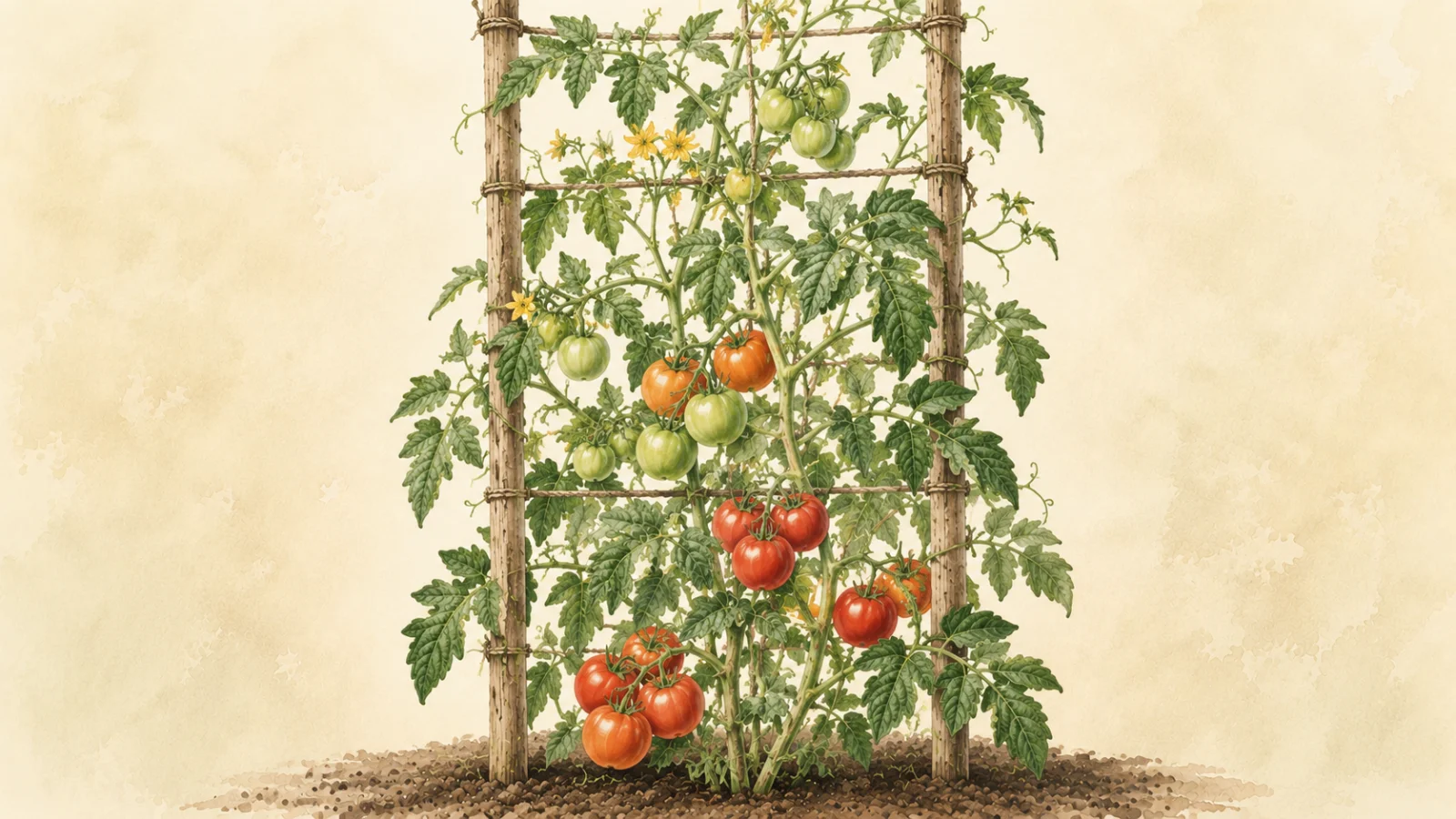
Botanical watercolor illustration of an indeterminate tomato plant (Solanum lycopersicum) growing vertically on a rustic wooden trellis, with green foliage, yellow flowers, and clusters of tomatoes at different stages of ripening against a soft cream background.

Indeterminate Tomato

Tomato

Solanum lycopersicum

Crop overview

Crop group
Solanaceous
Lifecycle
Annual
Growth habit
Continuously Growing Vine-Like Plant Requiring Tying Or Support

This profile covers indeterminate tomatoes trained vertically on a sturdy stake, string trellis, wire trellis or heavy-duty cage. Indeterminate varieties continue growing, flowering and fruiting until cold weather, disease or other stress ends production. It does not cover determinate, dwarf, patio or micro-dwarf tomatoes. Spacing and pruning requirements vary with the training system and cultivar, so follow the seed packet where its advice differs.

Variety examples

Sungold, Sweet Million, Big Beef, Brandywine, Cherokee Purple, Black Krim

Quick facts

Plant spacing
45 cm – 75 cm
Row spacing
90 cm
Support height
1.80 m – 2.40 m
Support strength
Heavy
Support types
Sturdy Stake, String Trellis, Vertical Wire Trellis, Heavy-Duty Tomato Cage, Cattle-Panel Trellis
Training method
Tying
Vertical suitability
Recommended
Sun requirement
Full Sun
Days to harvest
65–90 days

Support & training

Training requirements

Install the support at planting time. Secure the main stem and selected side stems with soft ties, clips or tomato twine as they grow. Check ties regularly so they do not cut into expanding stems. Redirect or tie new growth before it becomes heavy and tangled.

Pruning requirements

Pruning depends on the support system. For single-stem or narrow vertical training, remove side shoots or suckers regularly while they are small. For a large cage or multi-stem system, retain more stems and prune mainly to improve airflow and remove lower, damaged or diseased foliage. Avoid removing excessive healthy foliage, which can expose fruit to sunscald.

Growing setup guidance

Container

Minimum size: 40 L

Plants per container: 1

Grow one plant in a wide, stable container holding at least 40 L (about 10 US gal) of potting mix. A larger container of 60 L or more is preferable for vigorous or large-fruited varieties and in hot, dry or windy climates. Provide excellent drainage, regular feeding and consistent watering. Secure the support firmly so the mature plant and fruit cannot topple the container.

Raised bed

Plant beside a strong support installed at transplanting time. Position tall vines where they will not heavily shade shorter crops. Maintain consistent moisture, mulch to reduce soil splash and moisture fluctuations, and allow enough access for tying, pruning, harvesting and airflow.

In-ground

Install stakes, cages or trellis supports at transplanting time to avoid damaging established roots later. Plant in fertile, well-drained soil, mulch to limit soil splash and water at the base where possible. Rotate away from tomatoes, peppers, eggplants, potatoes and other closely related crops where soil-borne disease has been a problem.

Planting, pollination & harvest

Sowing / transplanting

Start seed indoors about 5–7 weeks before the intended planting-out date. Harden seedlings off gradually, then transplant outdoors after frost danger has passed, nights are reliably mild and the soil has warmed. Plant deeply enough to bury part of the lower stem, removing leaves that would sit below the soil line. Install the support at planting time.

Pollination

Tomato flowers are self-fertile, but movement from wind, insects or gentle vibration helps release pollen. Very hot or unusually cool conditions can reduce successful pollination and cause flowers to drop without setting fruit.

Warnings

Tomatoes are frost-tender. Irregular watering can contribute to fruit cracking and blossom-end rot, while wet foliage, soil splash, crowding and poor airflow increase disease risk. Extreme heat can reduce flower and fruit set. Watch for caterpillars, aphids, whiteflies, mites and locally important tomato diseases.

General notes

Days to harvest are usually counted from transplanting rather than sowing. Pick fruit when it has developed the expected mature colour and feels firm but no longer hard. Tomatoes beginning to colour can be picked and ripened indoors if cracking, pests, extreme weather or frost threaten. Support heavily laden branches and harvest regularly to reduce breakage.

Climate guidance

Planting season

Plant during a warm frost-free period. Spring and late summer to early autumn are often more productive than peak summer where conditions become extremely hot and humid.

Wet / dry season

Where summers are extremely wet, favour a somewhat drier warm planting window. Raised beds, mulch against soil splash and excellent drainage are particularly useful during rainy periods.

Soil temperature

Transplant once soil is at least about 16°C (60°F). In this climate, excessive heat and saturated soil are often greater concerns than insufficient warmth.

Frost sensitivity

Very frost-tender. Brief frost can severely damage or kill plants.

Heat sensitivity

Hot days combined with warm nights can cause heavy blossom drop and poor fruit set. Heat-set cultivars and planting outside the hottest part of summer may improve production.

Humidity / disease

Warm humidity, frequent rain and prolonged leaf wetness can create severe pressure from blights, bacterial diseases, leaf spots and fruit rots. Use resistant cultivars, generous airflow, soil-level watering and good sanitation.

Sowing guidance

Start seedlings under protection about 5–7 weeks before the intended transplant date. Transplant during a mild spell rather than immediately before extreme heat or prolonged rain.

Notes

Choose locally adapted cultivars with strong disease resistance and heat-set ability. Plants may decline earlier than they would in a dry temperate climate.

Ready to plan?

Open the planner with Indeterminate Tomato preselected.