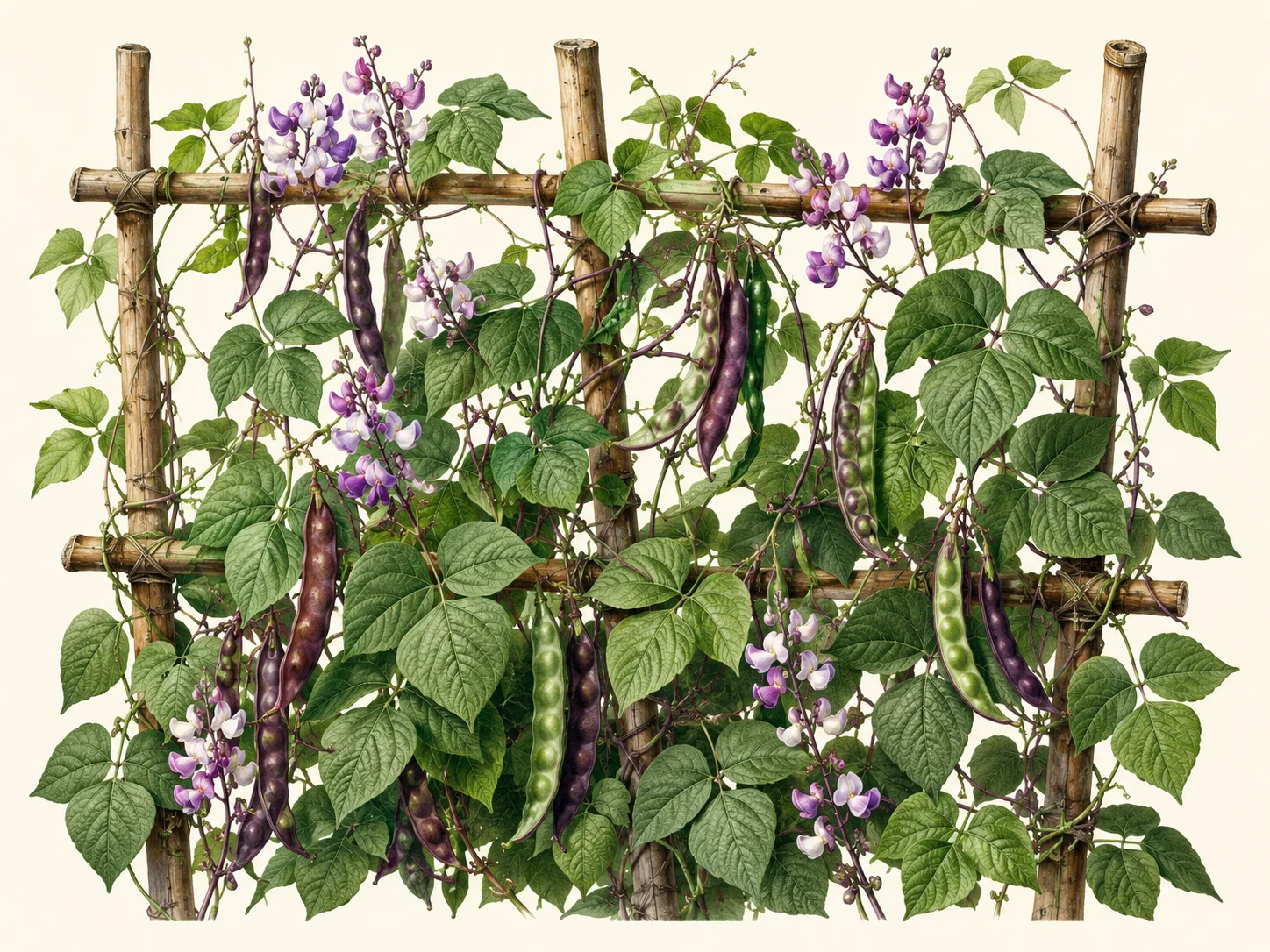
Botanical-style illustration of hyacinth bean (lablab) growing on a bamboo trellis, showing twining vines, broad green leaves, flowers, and hanging pods in a horizontal layout.

Hyacinth Bean / Lablab Bean

Hyacinth Bean / Lablab Bean / Indian Bean

Lablab purpureus

Crop overview

Crop group
Legume
Lifecycle
Perennial
Growth habit
Fast-Growing Tropical Perennial Twining Vine With Edible Cultivars And Showy Flowers

This profile covers edible cultivars of Lablab purpureus grown vertically for cooked young pods, fresh shell beans or mature dry seed. It is also called hyacinth bean, lablab bean, Indian bean, field bean or sem. Lablab is a short-lived tropical perennial but is commonly cultivated as an annual vegetable or ornamental vine. Not every ornamental hyacinth-bean seed line is intended for food. Use a named edible cultivar and follow cultivar-specific preparation guidance. This profile does not cover common pole bean, lima bean, winged bean or jack bean.

Variety examples

Thar Kiran, Thar Ganga, Ruby Moon

Quick facts

Plant spacing
30 cm – 60 cm
Row spacing
1.20 m
Support height
1.80 m – 3 m
Support strength
Heavy
Support types
Heavy Wire Trellis, Cattle-Panel Trellis, Sturdy Fence, Reinforced Garden Arch, Tall String Trellis, A-Frame Trellis
Training method
Twining
Vertical suitability
Recommended
Sun requirement
Full Sun
Days to harvest
75–150 days

Support & training

Training requirements

Guide young vines onto poles, wire, string or mesh until they begin twining. Spread vigorous shoots across the available support rather than allowing a dense mass to form. Redirect vines away from trees, roofs and neighbouring crops. Pinch the top where needed to keep harvesting within reach.

Pruning requirements

Routine pruning is optional. Redirect excessive shoots and remove dead, damaged, diseased or severely congested growth. In frost-free climates, established vines may be cut back after the main harvest to encourage manageable regrowth. Avoid heavy pruning during flowering and pod filling.

Growing setup guidance

Container

Minimum size: 50 L

Plants per container: 1

Grow one plant in a broad, stable container holding at least 50 L (about 13 US gal) of potting mix. Use a larger container where the vine will persist for more than one season. Provide excellent drainage, consistent moisture and a firmly anchored heavy trellis. The mature vine can become dense, tall and wind-catching. Feed moderately and avoid excessive nitrogen.

Raised bed

Plant beside a completed sturdy trellis. Raised beds help prevent waterlogging during heavy rain. Maintain consistent moisture and allow access for harvesting pods frequently. Position the support where the vigorous canopy will not overwhelm smaller crops.

In-ground

Plant in warm, fertile, freely draining soil beside a tall support. Lablab can tolerate varied soils once established but crops best with reliable moisture and good fertility. As a legume, it can form nitrogen-fixing nodules, but it still needs adequate phosphorus, potassium and other nutrients. In frost-free climates, established plants may persist and can be cut back after harvest.

Planting, pollination & harvest

Sowing / transplanting

Direct sow after frost danger has passed when soil and nights are thoroughly warm, preferably with soil at least about 18°C (65°F). Install the trellis before sowing. Plant seed approximately 2.5–4 cm deep according to soil texture and packet instructions. Where the warm season is limited, start seed in individual pots about 4–6 weeks before planting out, harden gradually and transplant with minimal root disturbance. Choose an early or day-neutral edible cultivar outside the tropics.

Pollination

Lablab is mainly self-pollinating and can normally set pods without a second variety. Bees and other insects visit the flowers and some crossing may occur. Flowering time varies strongly among cultivars. Some traditional types respond to shorter days and may remain vegetative until late in the season. Heat, drought, heavy rain or unsuitable day length can reduce pod set.

Warnings

Lablab is frost-tender and needs a long warm season to crop well. Use only a known edible cultivar. Mature dry seeds contain cyanogenic glycosides and other antinutritional compounds and can be harmful if eaten raw or improperly prepared. Young pods should be cooked. Mature dried beans require thorough boiling according to reliable regional guidance; some guidance recommends changing and discarding the cooking water several times. Do not assume ornamental seed sold only for flowers is suitable for eating. Watch for aphids, mites, caterpillars, pod borers, bean flies, rusts, leaf spots, root rots and viruses.

General notes

For vegetable use, harvest young pods while they are flat, tender and before the seeds enlarge and the pod walls become fibrous. Cook before eating. Fresh shell beans are harvested when seeds are full-sized but still soft. Dry beans are collected after pods and seeds have fully dried. Preparation differs among edible cultivars and cuisines. Follow trusted instructions for the specific harvest stage, and always cook mature beans thoroughly. The flowers are highly ornamental and attract pollinating insects, but food production should use an edible cultivar.

Climate guidance

Climate suitability: Possible

Planting season

Plant after frost danger when nights and soil are warm. Hot summers normally support vigorous growth.

Wet / dry season

Water consistently during flowering and pod filling and avoid saturation.

Soil temperature

Plant into soil at least about 18°C (65°F).

Frost sensitivity

Extremely frost-tender. Treat as an annual.

Heat sensitivity

Hot weather generally suits lablab, though extreme heat and drought can reduce pod set.

Humidity / disease

Hot rain can increase rust, leaf spots, root disease and insects.

Sowing guidance

Direct sow or transplant beside the completed support.

Notes

Choose a day-neutral or locally proven cultivar; short-day lines may flower late.

Ready to plan?

Open the planner with Hyacinth Bean / Lablab Bean preselected.