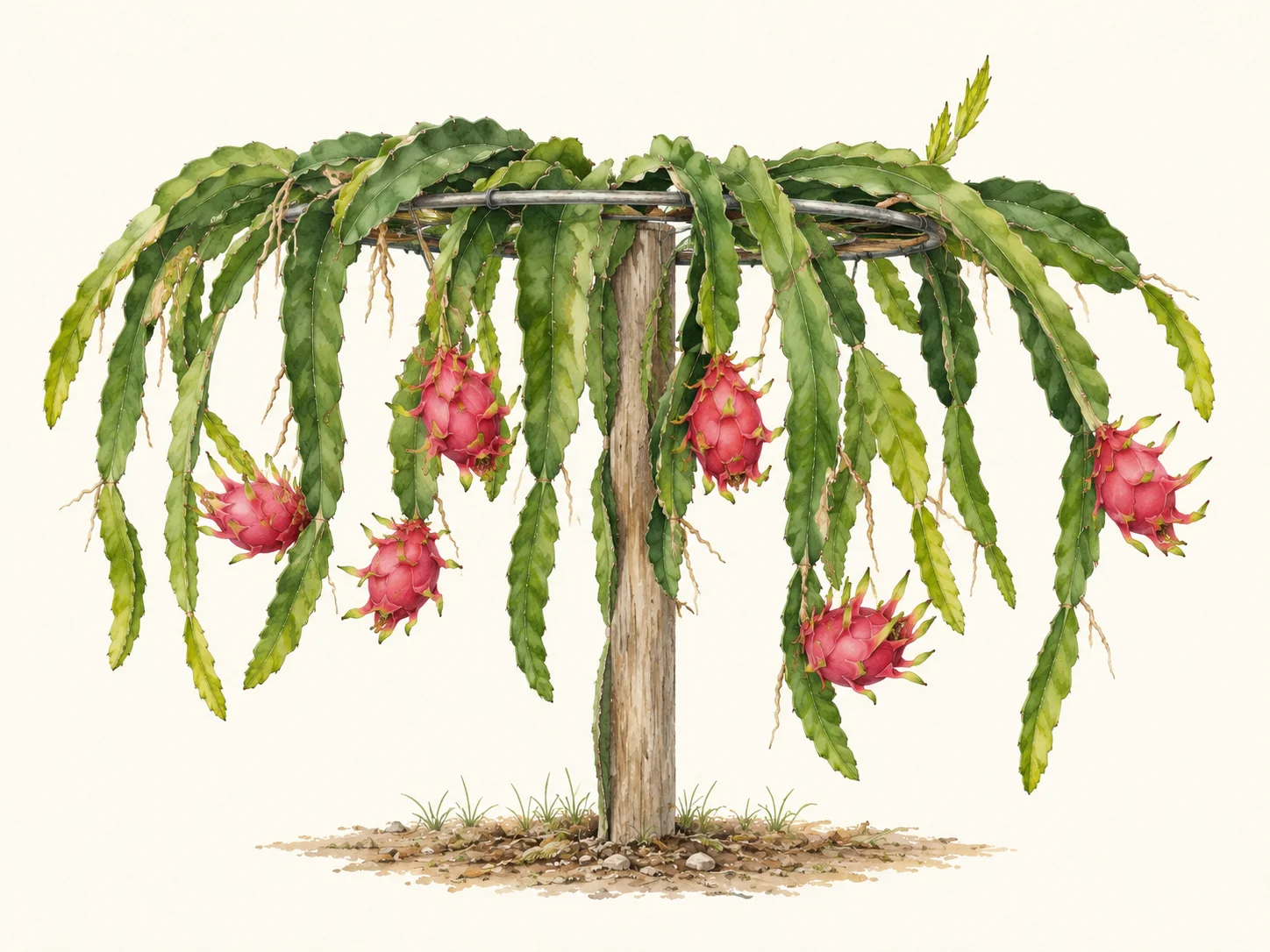
Dragon Fruit / Pitaya
Dragon Fruit / Pitaya / Pitahaya
Selenicereus spp. and hybrids (syn. Hylocereus spp.)
Crop overview
- Crop group
- Perennial Fruiting Cactus
- Lifecycle
- Perennial
- Growth habit
- Large Climbing Or Scrambling Cactus With Heavy Segmented Stems That Are Trained Up A Post And Allowed To Cascade From The Top
Covers common red-, pink-, white- and yellow-skinned dragon fruit grown on individual post-and-crown supports or very heavy arbors.
Variety examples
White-fleshed red skin, Red-fleshed types, Pink-fleshed types, Yellow dragon fruit, Self-fertile and self-sterile cultivars
Quick facts
- Plant spacing
- 3 m – 4.50 m
- Row spacing
- 4 m
- Support height
- 1.50 m – 1.90 m
- Support strength
- Extra Heavy
- Support types
- Reinforced Post-And-Crown Trellis, Heavy Arbor, Concrete Or Hardwood Post With Top Frame
- Training method
- Tying
- Vertical suitability
- Recommended
- Sun requirement
- Full Sun
- Days to harvest
- 180–365 days
Support & training
Training requirements
Tie upright stems to the post until they reach the crown, remove low side shoots, then tip leaders to stimulate branches that hang over the top.
Pruning requirements
Remove damaged, diseased, crowded and ground-touching stems after harvest. Thin repeatedly to maintain light, airflow and a manageable crown.
Growing setup guidance
Container
Minimum size: 100 L
Plants per container: 1
Use a very large, free-draining container integrated with a permanent heavy post. Avoid frequent watering and never allow the root zone to remain waterlogged.
Raised bed
Only suitable for a large, sharply drained bed built around a permanent reinforced post. Keep irrigation away from the crown.
In-ground
Plant in the warmest well-drained position available. The post and top frame must withstand several hundred pounds of mature stem weight.
Planting, pollination & harvest
Sowing / transplanting
Start from a healthy named cutting or nursery plant. Allow fresh cut ends to cure before planting. Train one or more main stems to the top of the support.
Pollination
Pollination varies by cultivar. Some are self-fertile, while others need compatible pollen. Night flowers may benefit from hand pollination where natural pollinators are unreliable.
Warnings
A weak support can collapse under mature stem weight. Waterlogging causes root and stem rot. Some cultivars need cross-pollination, so identify the cultivar before relying on one plant.
General notes
Cutting-grown plants may fruit within about 6-9 months in favourable conditions, but establishment and reliable cropping can take longer.
Climate guidance
Climate suitability: Specialist
Planting season
Plant after frost risk in a movable container or protected structure
Northern hemisphere months
May-Jun
Southern hemisphere months
Nov-Dec
Wet / dry season
Allow the root zone to dry between waterings
Soil temperature
Wait for warm soil and stable warm nights
Frost sensitivity
Frost tender; substantial winter protection is needed
Heat sensitivity
Very hot dry sun can scorch exposed stems
Humidity / disease
Avoid wet, stagnant overwintering conditions
Sowing guidance
Use a container system that can be protected in winter
Notes
Outdoor in-ground culture is generally impractical.