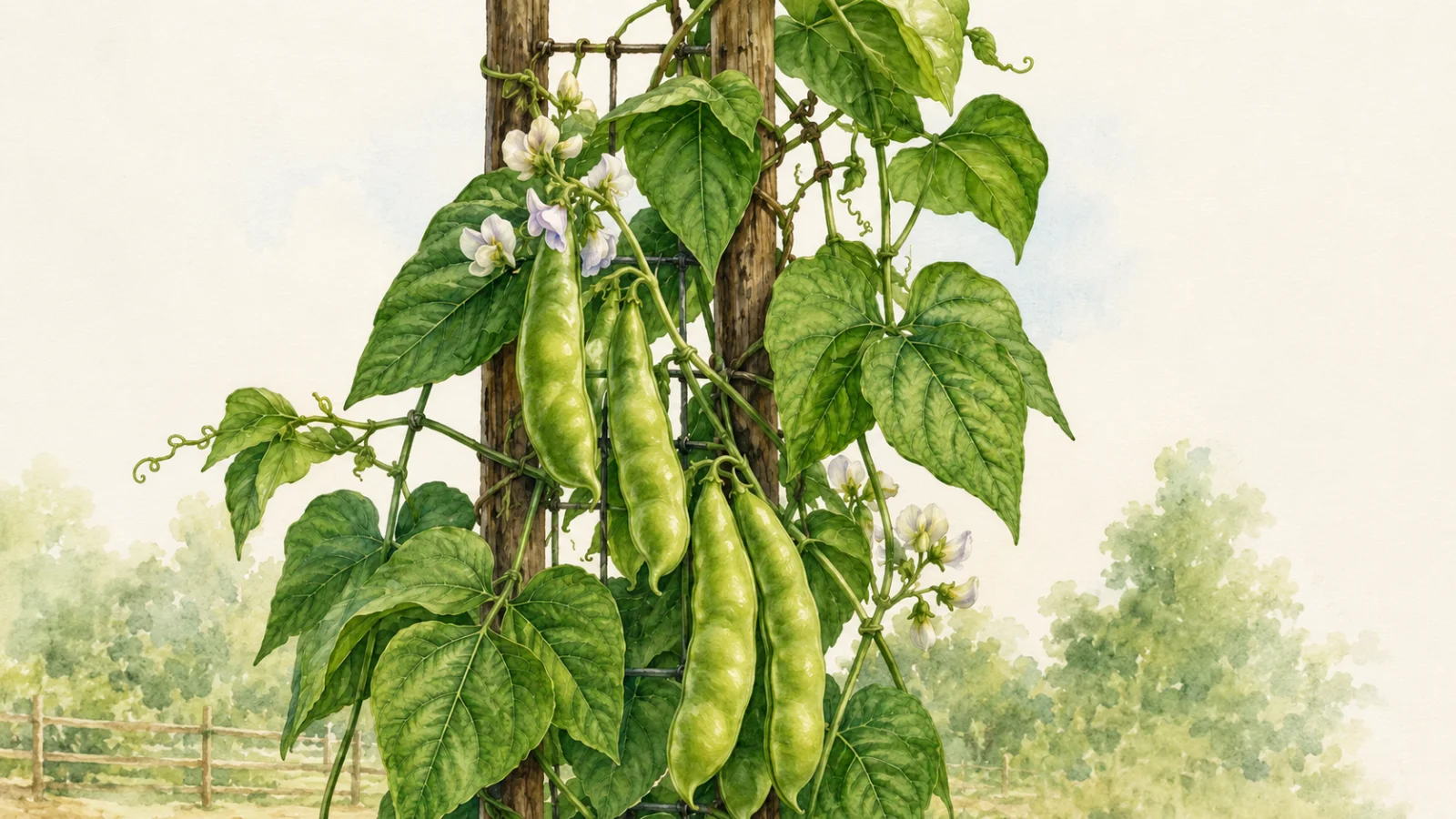
Botanical illustration of a climbing lima or butter bean vine growing on a wooden trellis, with broad green leaves, pale flowers and large green pods.

Climbing Lima Bean / Butter Bean / Madagascar Bean

Climbing Lima Bean / Butter Bean / Madagascar Bean / Pole Lima Bean

Phaseolus lunatus

Crop overview

Crop group
Legume
Lifecycle
Perennial
Growth habit
Vigorous Warm-Season Twining Vine Grown For Fresh Shell Or Dry Beans

This profile covers climbing forms of Phaseolus lunatus grown vertically for fresh shell beans or mature dry beans. It includes pole lima beans, climbing butter beans and long-lived tropical forms commonly sold as Madagascar beans. It does not cover bush lima beans, ordinary pole snap beans or other climbing bean species. Follow cultivar-specific guidance where maturity, day-length response or perennial behaviour differs. Phaseolus lunatus includes both annual and perennial forms. Most temperate garden cultivars are managed as annuals, while some tropical climbing forms may persist and crop for more than one season. This profile does not cover bush lima beans, common pole beans, scarlet runner beans or ornamental Phaseolus seed not sold as an edible cultivar. Lima-bean pods are normally shelled rather than eaten whole.

Variety examples

King of the Garden, Christmas Lima (also sold as Florida Speckled), Sieva, Willow Leaf Pole

Quick facts

Plant spacing
20 cm – 45 cm
Row spacing
90 cm
Support height
1.80 m – 3 m
Support strength
Heavy
Support types
Heavy Wire Trellis, Cattle-Panel Trellis, Tall String Trellis, Sturdy Fence, Reinforced Garden Arch, Bean Teepee
Training method
Twining
Vertical suitability
Recommended
Sun requirement
Full Sun
Days to harvest
85–120 days

Support & training

Training requirements

Install a tall, firmly anchored trellis before sowing. Guide young vines onto poles, string, wire or mesh until they begin twining. Redirect vigorous shoots across unused support space. Long-lived Madagascar-bean forms may become much larger than ordinary annual pole limas and require regular tying and redirection.

Pruning requirements

Routine pruning is generally unnecessary for annual pole cultivars. Redirect tangled vines and remove damaged, diseased or severely crowded growth. Perennial forms may be shortened after the main harvest or when they exceed the support. Avoid severe pruning during flowering and pod filling.

Growing setup guidance

Container

Minimum size: 50 L

Plants per container: 1

Grow one plant in a broad, stable container holding at least 50 L (about 13 US gal) of potting mix. Use a larger container for vigorous perennial Madagascar-bean forms or where the plant will be retained for more than one season. Provide excellent drainage, consistent moisture and a firmly anchored tall trellis. Container-grown vines may need frequent watering during flowering and seed filling, but the mix must not remain waterlogged. Feed moderately and avoid excessive nitrogen, which can produce lush vines with fewer pods.

Raised bed

Sow beside a completed, sturdy trellis. Raised beds are useful where drainage is poor, but keep the soil evenly moist during flowering and bean filling. Allow enough access to harvest fresh shell beans or collect dry pods without damaging the vine. Long-lived tropical forms may occupy the support for more than one season.

In-ground

Plant in warm, fertile, freely draining soil beside a tall support. Lima beans often perform well in coarser-textured or sandy loam soils provided moisture remains consistent. Avoid low ground where water remains after rain. As a legume, the crop can form nitrogen-fixing nodules, but adequate phosphorus, potassium and other nutrients are still required. In frost-free climates, perennial forms may be cut back and allowed to regrow if disease pressure and support capacity remain manageable.

Planting, pollination & harvest

Sowing / transplanting

Direct sow after frost danger has passed when soil is thoroughly warm, preferably at least about 18°C (65°F), and nights are mild. Cold, wet soil can cause seed decay and very slow emergence. Install the support before sowing. Plant seed approximately 2.5–4 cm deep according to soil texture and the cultivar packet. Direct sowing is normally best. Where the warm season is short, start seed in individual pots about 2–3 weeks before planting out, harden seedlings gradually and transplant with minimal root disturbance.

Pollination

Lima beans are capable of self-pollination, but bees and other insects frequently visit the flowers and can increase crossing between plants. A second variety is not normally required for pod set. Hot weather, dry roots, heavy rain or low pollinator activity can still contribute to flower drop and incomplete pod development. Saved seed may cross with nearby Phaseolus lunatus cultivars, so isolation is needed where varietal purity matters.

Warnings

Lima beans are frost-tender and require a longer, warmer season than many common beans. Cool soil and cool nights can prevent reliable establishment and seed filling. Raw or undercooked lima beans can contain harmful cyanogenic compounds and lectins. Never eat the fresh or dry seeds raw. Cook edible cultivars thoroughly using reliable food-safety guidance, and discard cooking water where the preparation method requires it. Do not use ornamental, wild or unidentified seed as food. Avoid prolonged waterlogging. Watch for aphids, mites, bean flies, caterpillars, pod borers, root-knot nematodes, rusts, bacterial blights, root rots and bean viruses.

General notes

For fresh shell beans, harvest when pods are plump and the seeds have reached full size but remain soft and moist. The seed colour often changes from green toward cream, white or the cultivar's mature pattern. For dry beans, leave pods until they are dry and the seeds rattle. If persistent rain or frost threatens, harvest mature pods and finish drying them under cover before shelling. Pick fresh shell beans regularly to encourage continued production. Pods are generally fibrous and are discarded after shelling. Thoroughly cook both fresh shell and dry lima beans before eating.

Climate guidance

Climate suitability: Recommended

Planting season

Plant in late spring after frost danger has passed and soil and nights are warm. Hot summers normally provide the main production period.

Wet / dry season

Water deeply and consistently during flowering and bean filling. Avoid repeated drought and saturation.

Soil temperature

Plant into soil at least about 18°C (65°F). Do not rush seed into cold spring ground.

Frost sensitivity

Extremely frost-tender. Harvest fresh shell beans and mature dry pods before autumn frost.

Heat sensitivity

Warm to hot weather suits lima beans, but extreme heat combined with dry roots may cause flower drop.

Humidity / disease

Hot rainy periods can increase rust, blight, root rot and insect pressure. Maintain airflow and drainage.

Sowing guidance

Direct sow beside the completed support. Use an early cultivar where autumn frost arrives quickly.

Notes

Pole cultivars may pause pod set during extreme heat and resume as temperatures moderate.

Ready to plan?

Open the planner with Climbing Lima Bean / Butter Bean / Madagascar Bean preselected.