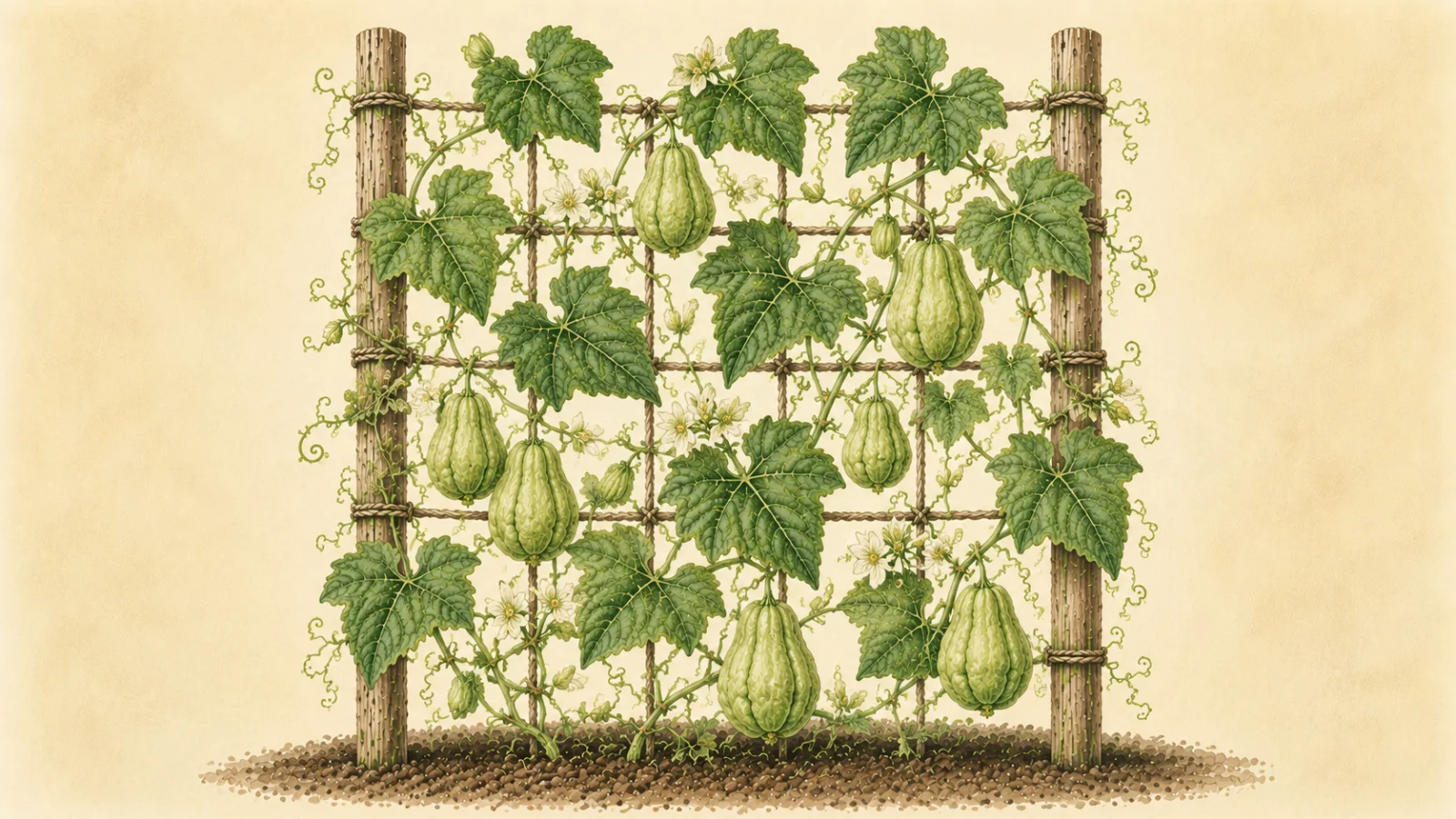
Chayote / Choko (Trellised)
Chayote / Choko / Vegetable Pear
Sechium edule
Crop overview
- Crop group
- Cucurbit
- Lifecycle
- Perennial
- Growth habit
- Extremely Vigorous Perennial Climbing Vine With Branched Tendrils
This profile covers cultivated chayote, known as choko in Australia, grown vertically for its edible fruit. It includes smooth, wrinkled and spiny green or pale-fruited forms of Sechium edule. Chayote is a tropical or subtropical perennial and may remain productive for several years in a suitable frost-free climate. In colder areas it may be grown as a long-season annual, although fruit production is often unreliable because flowering is stimulated by short days. This profile focuses on fruit production. Young shoots, leaves, tuberous roots and the single soft seed are also eaten in some cuisines, but they have different harvesting and preparation requirements. It does not cover other pear-shaped gourds or unrelated crops also called vegetable pear.
Variety examples
Smooth Green, Spiny Green, White Chayote
Quick facts
- Plant spacing
- 1.80 m – 3.60 m
- Row spacing
- 3 m
- Support height
- 1.80 m – 3 m
- Support strength
- Extra Heavy
- Support types
- Reinforced Pergola, Extra-Heavy Cattle-Panel Arch, Overhead-Wire Trellis, Heavy Welded-Wire Arbor, Strong Permanent Fence
- Training method
- Tendril
- Vertical suitability
- Specialist
- Sun requirement
- Full Sun
- Days to harvest
- 120–180 days
Support & training
Training requirements
Pruning requirements
Growing setup guidance
Container
Minimum size: 100 L
Plants per container: 1
Grow one plant in a very large, broad and stable container holding at least 100 L (about 26 US gal) of potting mix. A larger container is strongly preferable where the vine will be retained for more than one season. Provide excellent drainage, consistent moisture, regular feeding and an independently anchored extra-heavy support. Do not rely on a lightweight pot-mounted trellis because the mature vine can extend more than 10 m and develop a very large, wind-catching canopy. Container-grown plants may need frequent watering during hot or dry weather, but the root zone must never remain waterlogged. Prune regularly to keep growth within the available support.
Raised bed
In-ground
Planting, pollination & harvest
Sowing / transplanting
Pollination
Warnings
General notes
Climate guidance
Climate suitability: Specialist