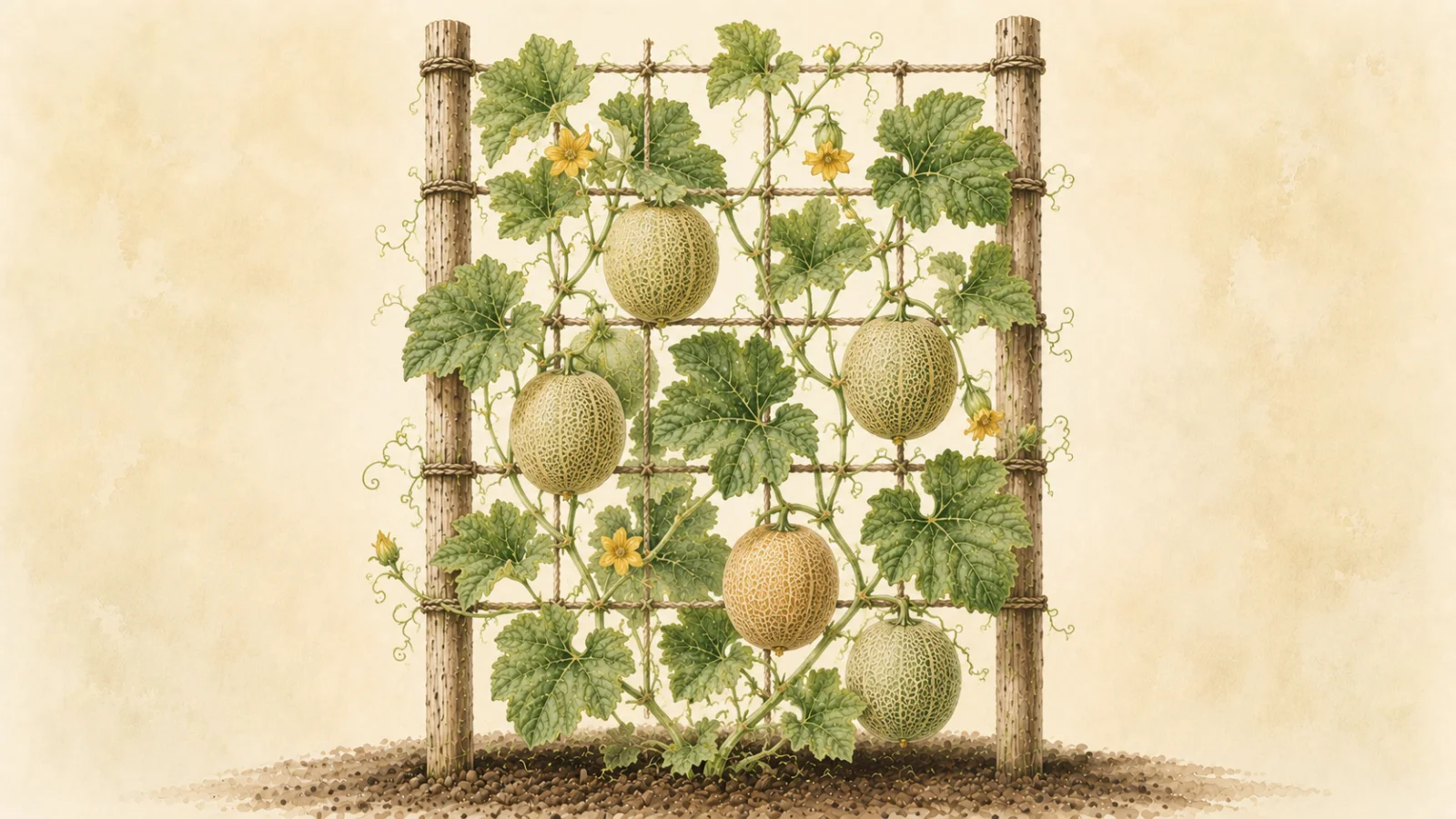
Cantaloupe / Muskmelon (Trellised)
Cantaloupe / Muskmelon / Rockmelon
Cucumis melo
Crop overview
- Crop group
- Cucurbit
- Lifecycle
- Annual
- Growth habit
- Vigorous Trailing Vine With Tendrils
This profile covers small-fruited cantaloupe and muskmelon cultivars, including crops commonly called rockmelon in Australia, trained vertically on a strong trellis. Every developing fruit must be supported in a sling. It does not cover watermelon, honeydew, casaba, Crenshaw or other large-fruited melons, compact bush cultivars, or unsupported hanging fruit. Harvest signs differ between netted muskmelons that naturally slip from the stem and true cantaloupes or specialty cultivars that must be cut, so follow cultivar-specific guidance where it differs.
Variety examples
Minnesota Midget, Sugar Cube, Charentais, Petit Gris de Rennes, Tasty Bites
Quick facts
- Plant spacing
- 45 cm – 75 cm
- Row spacing
- 1.20 m
- Support height
- 1.50 m – 2.10 m
- Support strength
- Heavy
- Support types
- Cattle-Panel Trellis, Heavy Welded-Wire Trellis, Reinforced A-Frame Trellis, Sturdy Wire Fence, Heavy-Duty Trellis Netting
- Training method
- Tendril
- Vertical suitability
- Specialist
- Sun requirement
- Full Sun
- Days to harvest
- 70–95 days
Support & training
Training requirements
Pruning requirements
Fruit slings
Growing setup guidance
Container
Minimum size: 50 L
Plants per container: 1
Grow one compact, small-fruited cultivar in a broad, stable container holding at least 50 L (about 13 US gal) of potting mix. Larger containers are preferable in hot, dry or windy conditions. Provide excellent drainage, regular feeding and consistent watering. Anchor the trellis independently or very firmly so the mature vine and suspended fruit cannot topple the container. Support every melon in a quick-drying sling and check soil moisture frequently during flowering and fruit enlargement.
Raised bed
In-ground
Planting, pollination & harvest
Sowing / transplanting
Pollination
Warnings
General notes
Climate guidance
Climate suitability: Recommended