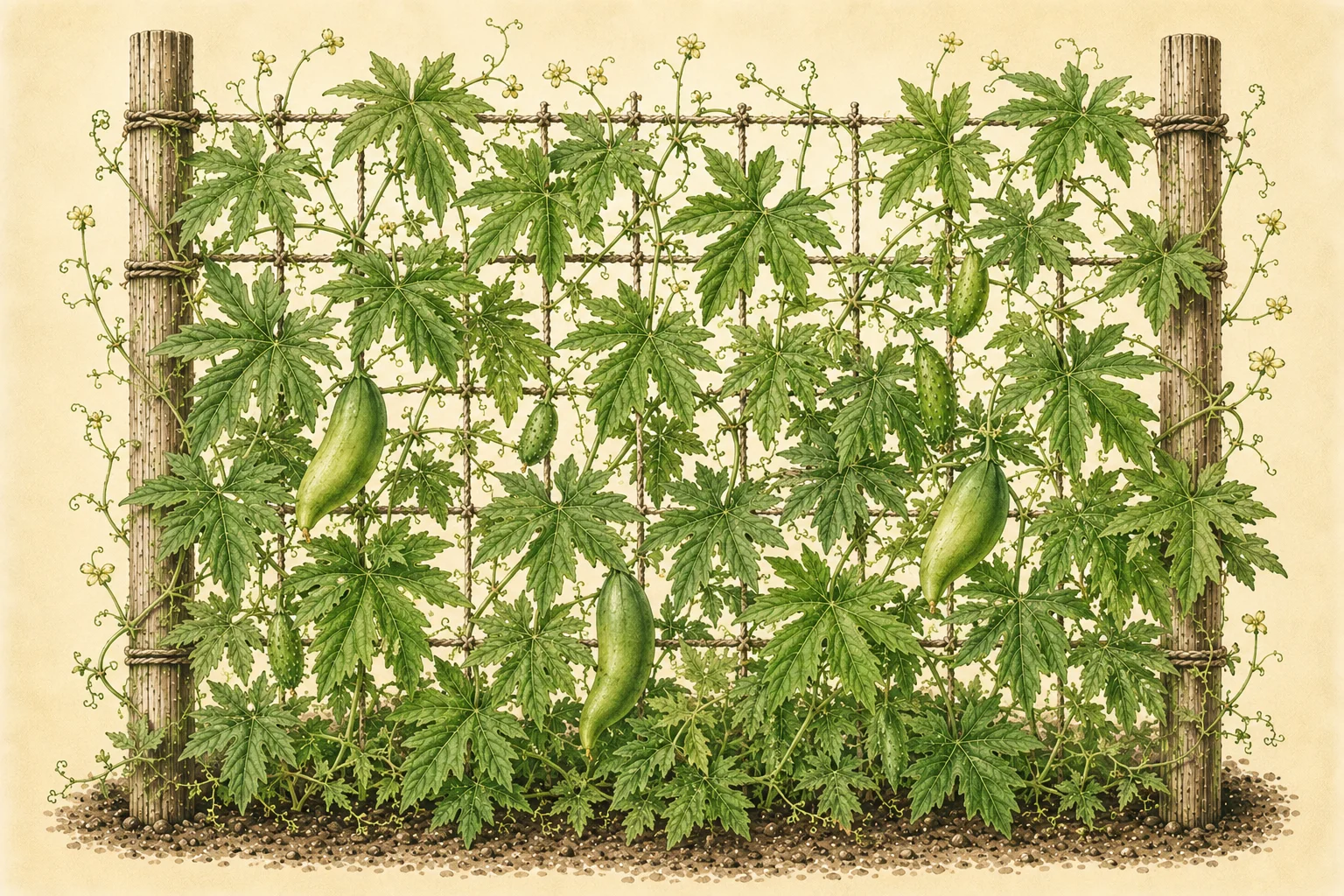
Botanical watercolor illustration of caigua (Cyclanthera pedata) growing densely on a rustic wooden trellis, with deeply lobed green leaves, curling tendrils, small pale flowers, and a few smooth and lightly spined green fruits at different stages of maturity against a soft cream background.

Caigua / Achocha (Trellised)

Caigua / Achocha / Stuffing Cucumber

Cyclanthera pedata

Crop overview

Crop group
Cucurbit
Lifecycle
Annual
Growth habit
Vigorous Climbing Vine With Tendrils And Hollow Edible Fruit

This profile covers Cyclanthera pedata grown vertically for its edible fruit, commonly called caigua, achocha, stuffing cucumber or slipper gourd. Young fruit may be eaten whole while still tender. Larger mature-green fruit develops a hollow centre and is commonly opened, deseeded and stuffed or sliced for cooking. It does not cover the smaller explosive cucumber Cyclanthera brachystachya, ordinary cucumbers, luffa or other South American cucurbits. Caigua is normally grown as an annual crop.

Variety examples

Caigua Gigante, Caigua de Rellenar

Quick facts

Plant spacing
75 cm – 1 m
Row spacing
1.50 m
Support height
1.80 m – 2.40 m
Support strength
Heavy
Support types
Heavy Trellis Netting, Sturdy Wire Trellis, Cattle-Panel Trellis, Reinforced Garden Arch, Sturdy Fence, A-Frame Trellis
Training method
Tendril
Vertical suitability
Recommended
Sun requirement
Full Sun
Days to harvest
100–140 days

Support & training

Training requirements

Install a sturdy vertical net, wire trellis, fence or arch before sowing or transplanting. Guide young shoots toward the support until the tendrils attach. Spread vigorous shoots through open parts of the trellis and redirect growth that begins smothering neighbouring plants. Keep fruit visible and accessible for frequent harvesting.

Pruning requirements

Pruning is optional. Redirect or shorten excessive growth and remove damaged, diseased or severely congested vines where needed for airflow and access. Avoid heavy pruning because fruit develops on continuing lateral growth. Frequent harvesting is normally more useful than strict pruning for maintaining production.

Growing setup guidance

Container

Minimum size: 50 L

Plants per container: 1

Grow one plant in a broad, stable container holding at least 50 L (about 13 US gal) of potting mix. A larger container is preferable where the growing season is long. Provide a firmly anchored heavy trellis, consistent moisture and excellent drainage. The vine can become large and dense even though the individual fruit is light. Feed moderately and avoid excessive nitrogen that encourages foliage at the expense of fruit.

Raised bed

Plant beside a completed sturdy trellis. Raised beds are useful where heavy rain or poorly drained soil would otherwise keep the root zone wet. Allow the vine substantial trellis space and maintain access for frequent harvesting. Caigua can cover neighbouring crops rapidly, so redirect shoots and prevent them from climbing into trees or structures.

In-ground

Plant in deep, fertile, freely draining soil beside an installed support. A slightly acidic to neutral soil is suitable, and highly saline soil or irrigation water should be avoided. Maintain consistent moisture without waterlogging the roots. Allow generous canopy space because the vine branches freely and can produce heavily over a long season.

Planting, pollination & harvest

Sowing / transplanting

Direct sow after frost danger has passed when soil is warm. Germination is most reliable between about 20°C and 30°C (68–86°F), with approximately 25°C (77°F) favourable. Where the season is short, start seed in individual containers about 4–6 weeks before planting out. Harden seedlings gradually and transplant with minimal root disturbance. Install the permanent trellis before planting. Sow seed about 2.5–4 cm deep, or follow the seed supplier's guidance where it differs.

Pollination

Caigua produces separate male and female flowers on the same plant. Bees and other insects normally move pollen between the flowers. One plant can produce both flower types, but pollinator activity is important for dependable fruit set. Avoid insecticide use while flowers are open and pollinators are active.

Warnings

Caigua is frost-tender and requires enough frost-free time to reach its relatively late harvest. The vigorous vine can overwhelm nearby plants and lightweight supports. Check ties and trellis anchors regularly. Avoid saline soil or irrigation water and prolonged waterlogging. Watch for aphids, mites, whiteflies, cucumber beetles, caterpillars, powdery mildew, downy mildew, leaf spots, root rots and cucurbit viruses. Mature seeds become hard, dark and sharply edged. Remove them before cooking larger fruit. Fruit allowed to become overmature may become fibrous and less pleasant to eat.

General notes

Harvest small fruit while tender if it will be eaten whole. Larger fruit can be harvested while still green and firm, then opened and the darkening seeds removed before stuffing or slicing. Production may begin around 100 days after establishment and continue for several weeks or months where frost and severe heat do not intervene. Pick regularly to maintain quality and continued production. The exact preferred fruit size varies substantially between small-fruited and large-fruited caigua selections.

Climate guidance

Climate suitability: Possible

Planting season

Plant in late spring after frost danger has passed. Establish the vine early enough to mature fruit before autumn frost.

Wet / dry season

Water deeply and consistently during flowering and fruit development. Avoid repeated drought and saturation.

Soil temperature

Plant once soil is warm, preferably at least about 18°C (65°F). Seed germinates best at warmer propagation temperatures.

Frost sensitivity

Very frost-tender. Treat the crop as an annual and harvest usable fruit before autumn frost.

Heat sensitivity

Warm weather promotes growth, but prolonged extreme heat and hot dry winds may reduce flower retention and fruit set. Maintain moisture.

Humidity / disease

Hot rainy periods may increase mildew, leaf spots, mites, aphids and root disease. Train vines openly and avoid waterlogging.

Sowing guidance

Direct sow into warm soil or transplant seedlings started 4–6 weeks earlier. Install the support before planting.

Notes

A long warm autumn improves yield. In very hot inland areas, flowering may improve as temperatures moderate later in the season.

Ready to plan?

Open the planner with Caigua / Achocha (Trellised) preselected.