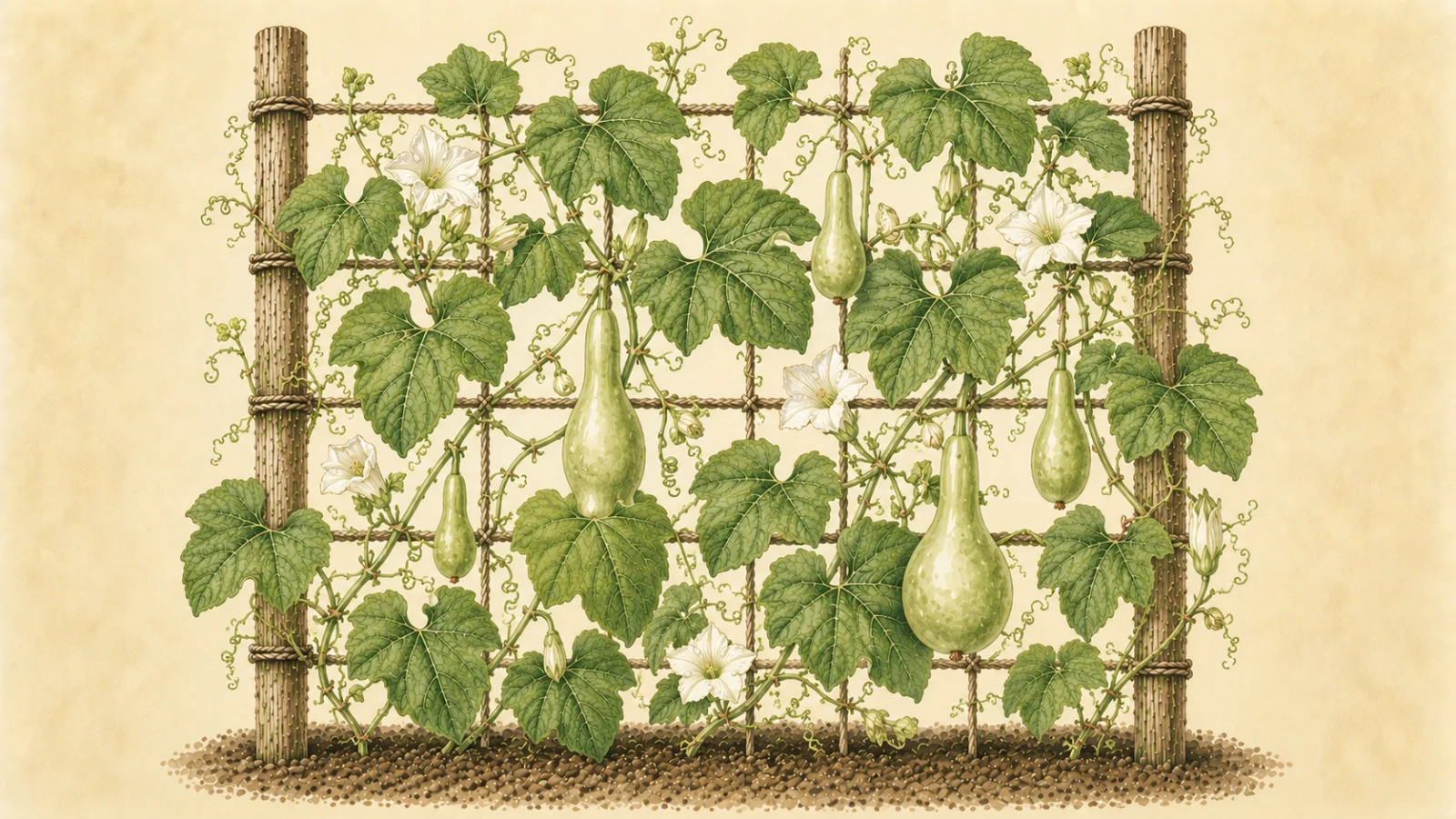
Botanical watercolor illustration of bottle gourd or New Guinea bean (Lagenaria siceraria) climbing a rustic wooden trellis, with broad green leaves, curling tendrils, white flowers, and pale green pear-shaped gourds at different stages of growth against a soft cream background.

Bottle Gourd / Cucuzza / New Guinea Bean (Trellised)

Bottle Gourd / Cucuzza / New Guinea Bean

Lagenaria siceraria

Crop overview

Crop group
Cucurbit
Lifecycle
Annual
Growth habit
Extremely Vigorous Annual Climbing Vine With Tendrils And Large White Flowers

This profile covers edible forms of Lagenaria siceraria grown vertically, including cucuzza, New Guinea bean, opo squash, long gourd, calabash and bottle-gourd types. Young tender fruit is harvested as a vegetable. Fully mature fruit becomes hard and fibrous and may be dried for craft or container use, but it is no longer eaten as a vegetable. It does not cover luffa, snake gourd, wax gourd, ornamental Cucurbita gourds or wild bitter gourds. New Guinea bean is not a true bean; it is an edible bottle gourd.

Variety examples

Cucuzza, Longissima, Opo, Long Gourd, Calabash

Quick facts

Plant spacing
90 cm – 1.50 m
Row spacing
1.80 m
Support height
1.80 m – 3 m
Support strength
Extra Heavy
Support types
Cattle-Panel Trellis, Reinforced Pergola, Heavy Welded-Wire Trellis, Extra-Heavy Garden Arch, Strong Permanent Fence, Overhead-Wire Trellis
Training method
Tendril
Vertical suitability
Recommended
Sun requirement
Full Sun
Days to harvest
60–120 days

Support & training

Training requirements

Install a firmly braced cattle panel, heavy wire trellis, pergola, arbor or strong fence before sowing or transplanting. Guide young shoots toward the support until the tendrils attach. Spread vigorous growth across the available structure and redirect vines before they enter trees, roofs or neighbouring crops. Allow long fruit to hang freely so it develops straight. Support any unusually large or heavy fruit with a sling attached to the frame, especially where fruit is being left to mature fully.

Pruning requirements

Pruning is optional but useful for controlling the exceptionally vigorous vine. Redirect or shorten growth that exceeds the allocated structure and remove damaged, diseased or severely crowded shoots. Some growers pinch the main vine once it is about 2.5–3 m long to encourage lateral growth and flowering. Avoid removing all laterals because fruit develops on branching growth. Where mature dried gourds are the goal, remove very late flowers and small fruit toward the end of the season so established fruit can finish.

Growing setup guidance

Container

Minimum size: 60 L

Plants per container: 1

Grow one plant in a broad, stable container holding at least 60 L (about 16 US gal) of potting mix. A larger container is strongly preferable for long-season growth or mature-gourd production. Provide excellent drainage, abundant moisture, regular feeding and an independently anchored extra-heavy support. The vine can exceed 7 m and develop a large, wind-catching canopy with heavy fruit. Check moisture frequently during hot weather without leaving the potting mix waterlogged. Harvest edible fruit regularly to limit weight on the structure.

Raised bed

Plant beside a completed and strongly braced trellis, arch or pergola. Raised beds are useful in heavy-rainfall climates because they improve drainage around the roots. Allow substantial canopy space and leave clear access for training and harvesting. Long fruit should hang freely so it remains straight and clean rather than becoming trapped in mesh.

In-ground

Plant in warm, fertile, moisture-retentive but freely draining soil beside an extra-heavy support. Allow generous root and canopy space because a single vine can cover a large fence or arbor. Maintain consistent moisture during flowering and fruit enlargement, but avoid standing water. Keep vines away from roofs, gutters, powerlines and trees unless those structures are deliberately being used and can safely carry the load.

Planting, pollination & harvest

Sowing / transplanting

Direct sow after all frost danger has passed when soil is thoroughly warm, preferably around 20°C (68°F) or above. Where the warm season is shorter, start seed in individual containers about 3–4 weeks before planting out. Harden seedlings gradually and transplant carefully after nights become mild. Sow about 2–4 cm deep, following the cultivar packet where it differs. Install the permanent support before planting because the vine grows rapidly once established.

Pollination

Bottle gourd produces separate male and female flowers on the same plant. The large white flowers open mainly in the evening and are commonly pollinated by moths and other night-active insects. Bees and other insects may visit flowers that remain open into the morning. Where female flowers repeatedly fail to develop fruit, hand pollination at dusk or early morning may improve fruit set. Avoid insecticide use while flowers are open and pollinators are active.

Warnings

Bottle gourd is very frost-tender and performs poorly in cold soil. The vine can become extremely large and heavy and may overwhelm lightweight trellises, trees, roofs or nearby crops. Check structural anchors regularly. Watch for powdery mildew, downy mildew, mosaic viruses, Fusarium wilt, anthracnose, root disease, fruit rot, aphids, mites, whiteflies, cucumber beetles and caterpillars. Do not eat fruit or juice with an unusually strong or unpleasant bitter taste. Bitter bottle gourd can contain high concentrations of cucurbitacins and should be spat out and discarded. Fully mature hard fruit is not eaten as a vegetable. Large hanging fruit may require support to prevent vine or trellis damage.

General notes

For vegetable use, harvest fruit while the skin is tender, the flesh is pale and the seeds are still soft. Preferred size varies greatly between cultivars. Long cucuzza or New Guinea bean types are often harvested around 15–45 cm long, although some remain tender to about 60 cm. Opo and bottle-shaped forms should also be judged by tenderness rather than maximum length. Cut fruit from the vine rather than pulling it. Peel firmer-skinned fruit and remove developed seeds as needed before cooking. For craft use, leave selected fruit until the rind is hard, the stem dries and the fruit becomes lightweight. Mature gourds require a warm, ventilated curing period and should not be confused with the young edible stage.

Climate guidance

Climate suitability: Recommended

Planting season

Plant in late spring after frost danger has passed and establish early enough to use the full hot summer.

Wet / dry season

Water deeply and consistently during flowering and fruit enlargement. Ensure rapid drainage after summer storms.

Soil temperature

Plant once soil reaches about 20°C (68°F) or warmer. Avoid cold spring ground.

Frost sensitivity

Very frost-tender. Harvest edible fruit and any mature or nearly mature gourds before autumn frost.

Heat sensitivity

Hot summers generally suit the crop. Extreme heat combined with drought can reduce flowering and fruit growth.

Humidity / disease

Hot rainy periods may increase mildew, leaf disease, aphids, mites and fruit rot. Maintain airflow and avoid waterlogging.

Sowing guidance

Direct sow into warm soil or transplant seedlings started 3–4 weeks earlier. Install the support before planting.

Notes

Long edible fruit can develop quickly in peak summer. Mature dried gourds require enough warm autumn weather to harden fully.

Ready to plan?

Open the planner with Bottle Gourd / Cucuzza / New Guinea Bean (Trellised) preselected.