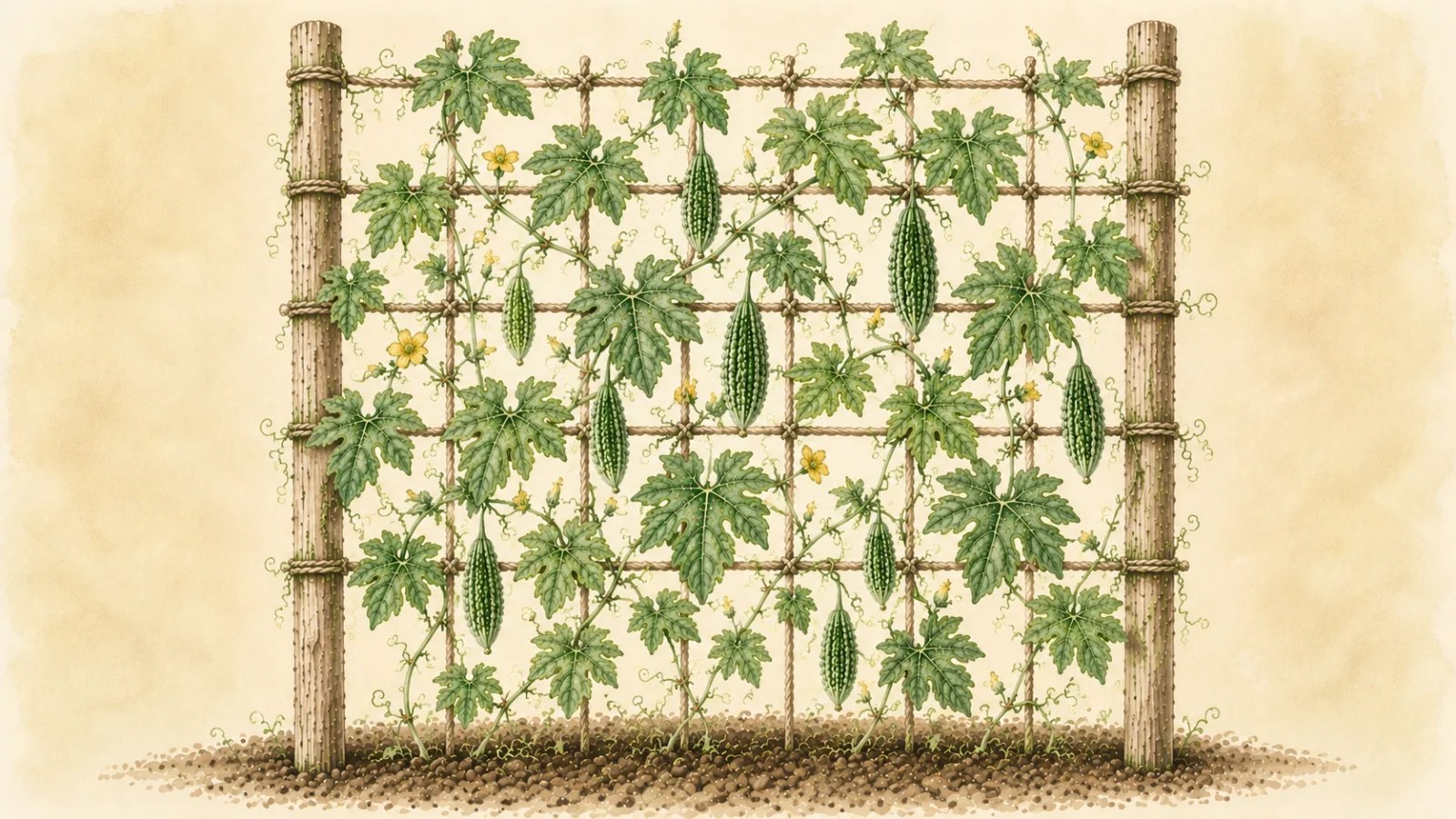
Botanical watercolor illustration of bitter melon (Momordica charantia) growing vertically on a rustic wooden trellis, with deeply lobed green leaves, yellow flowers, curling tendrils, and multiple bumpy green fruits of different sizes against a soft cream background.

Bitter Melon / Bitter Gourd

Momordica charantia

Crop overview

Crop group
Cucurbit
Lifecycle
Annual
Growth habit
Vigorous Climbing Vine With Tendrils

This profile covers cultivated Chinese-type and Indian-type bitter melon grown vertically for its immature edible fruit. It does not cover wild or weedy balsam-pear forms, ornamental Momordica species or ripe fruit grown primarily for seed. Bitter melon may escape cultivation and self-seed in warm climates, so prevent ripe fruit from splitting where spreading is a concern.

Variety examples

Taiwan Large, India Long Green, Chinese Large, Palee, White Pearl

Quick facts

Plant spacing
90 cm – 1.50 m
Row spacing
1.80 m
Support height
1.80 m – 2.40 m
Support strength
Heavy
Support types
Cattle-Panel Trellis, Heavy Welded-Wire Trellis, Reinforced A-Frame Trellis, Sturdy Wire Fence, Heavy-Duty Trellis Netting
Training method
Tendril
Vertical suitability
Recommended
Sun requirement
Full Sun
Days to harvest
50–80 days

Support & training

Training requirements

Install and brace the trellis before sowing or transplanting. Guide young shoots toward the support until tendrils begin attaching after the plant has developed several true leaves. Spread vigorous side shoots across the available support rather than allowing the entire plant to gather in one dense section. Loosely tie wandering shoots where necessary.

Pruning requirements

Pruning is optional. Redirect vigorous side vines and remove damaged, diseased or severely crowded growth where needed for airflow and access. Avoid excessive pruning because healthy leaves support continued flowering and fruit development.

Growing setup guidance

Container

Minimum size: 50 L

Plants per container: 1

Grow one plant in a broad, stable container holding at least 50 L (about 13 US gal) of potting mix. Larger containers are preferable in long, hot growing seasons. Provide excellent drainage, regular feeding and consistent moisture. Anchor the trellis independently or very firmly because the mature vine becomes large and wind-catching. Harvest frequently and prevent ripe fruit from dropping seed into surrounding soil.

Raised bed

Plant beside a completed, strongly braced trellis. Allow enough room to train the highly branched vine without smothering neighbouring crops. Raised beds are especially useful in climates with heavy seasonal rain. Maintain even moisture but ensure that excess water drains quickly.

In-ground

Plant in warm, fertile and freely draining soil beside an installed support. Maintain consistent moisture through flowering and fruit production but avoid saturated soil. Where bitter melon is considered invasive or potentially weedy, harvest before the fruit turns orange and splits, and remove volunteer seedlings.

Planting, pollination & harvest

Sowing / transplanting

Direct sow once frost danger has passed and the soil is warm and moist. Bitter melon seed has a thick, hard coat and may germinate slowly. Soaking seed overnight or carefully nicking the outer coat may speed germination. In short-season climates, start seedlings indoors about 4–6 weeks before planting out. Harden seedlings gradually and transplant carefully into warm soil. Install the support before planting.

Pollination

Bitter melon produces separate male and female flowers on the same plant. Bees and other insects normally transfer pollen between flowers. The first flowers are often male and naturally fall without producing fruit. Where insect activity is low, hand pollination can be performed during the morning using fresh male flowers.

Warnings

Bitter melon is extremely frost-tender and performs poorly in cold soil. Watch for aphids, mites, whiteflies, cucumber beetles, fruit flies, caterpillars, powdery mildew, downy mildew, gummy stem blight, anthracnose, bacterial diseases, wilts and cucurbit viruses. The mature fruit changes from green to yellow or orange and eventually splits open, scattering seed. Prevent fruit from ripening on the plant where self-seeding or escape into natural areas is a concern. This profile provides gardening and culinary-harvest guidance, not medical advice. Bitter melon should not be treated as a substitute for diabetes medication or other medical care.

General notes

Harvest fruit while green or only beginning to lighten, before it becomes orange, soft or split. Chinese types are generally longer and smoother, while Indian types are shorter, more pointed and more deeply ridged. Pick regularly because fruit can pass quickly from edible maturity to ripe orange fruit. Cut fruit from the vine rather than pulling against the trellis. For ordinary culinary use, halve the immature fruit and remove the seeds and surrounding pith before cooking according to the chosen recipe.

Climate guidance

Climate suitability: Recommended

Planting season

Plant after frost danger has passed and nights and soil are reliably warm. The hot part of summer normally provides the main production period.

Wet / dry season

Water deeply during dry weather and avoid repeated swings between drought and saturation.

Soil temperature

Plant into soil at least about 18°C (65°F). Avoid rushing seedlings into cold spring ground.

Frost sensitivity

Extremely frost-tender. Harvest all usable fruit before autumn frost.

Heat sensitivity

Hot summers suit bitter melon, provided moisture remains available. Extreme heat combined with drought may reduce flower retention and fruit quality.

Humidity / disease

Warm, rainy periods increase foliar-disease pressure. Maintain airflow and avoid unnecessary overhead watering.

Sowing guidance

Direct sow into warm soil or transplant seedlings started 4–6 weeks earlier. Install the trellis before planting.

Notes

Harvest frequently during peak summer because fruit can ripen and split very quickly.

Ready to plan?

Open the planner with Bitter Melon / Bitter Gourd preselected.