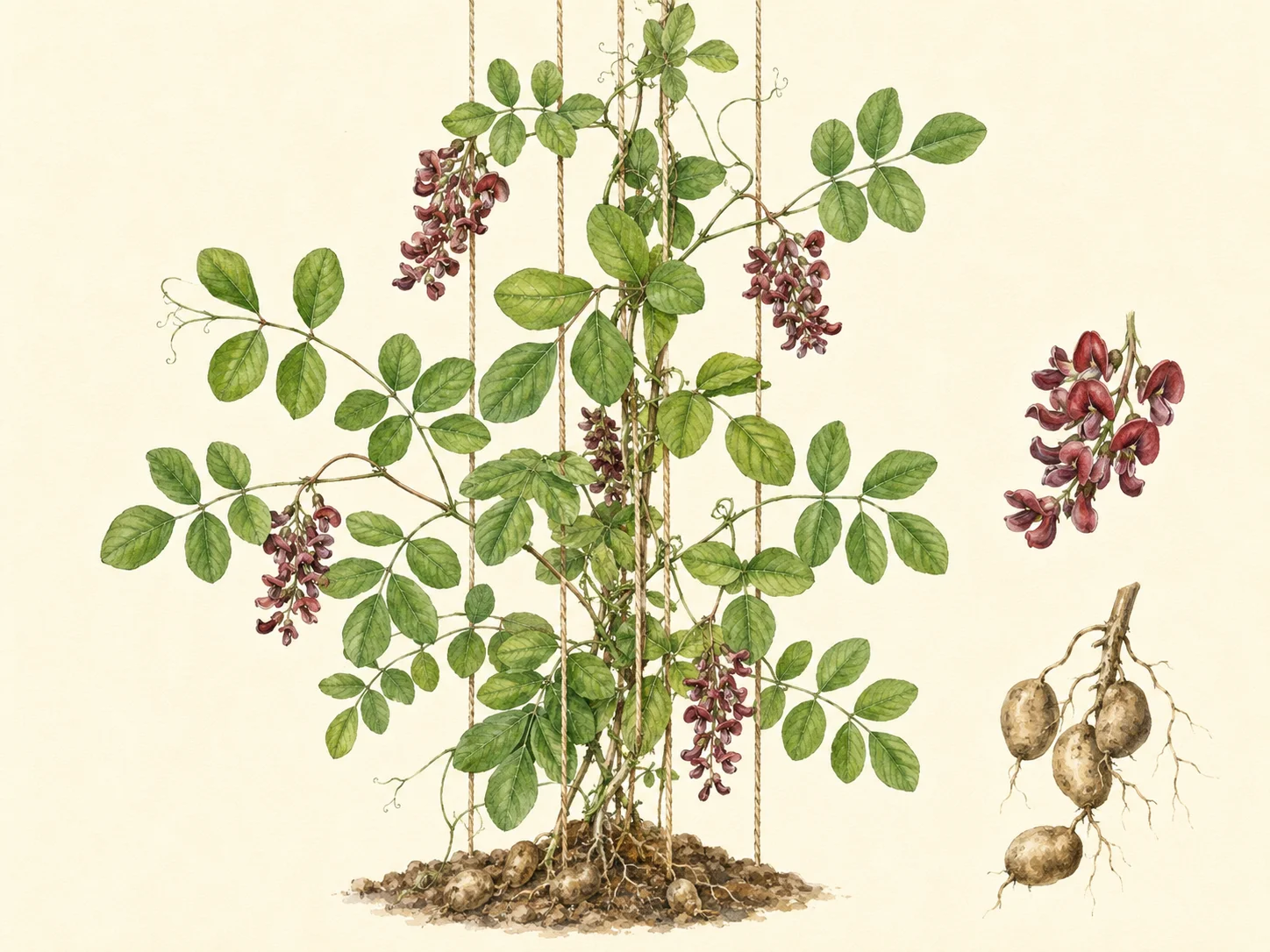
American Groundnut / Hopniss
American Groundnut / Hopniss / Potato Bean
Apios americana
Crop overview
- Crop group
- Perennial Edible Tuber Vine
- Lifecycle
- Perennial
- Growth habit
- Deciduous Herbaceous Twining Vine That Regrows From Chains Of Edible Underground Tubers And Can Form Colonies
Covers Apios americana grown for cooked tubers and as a perennial edible climber. Plants spread underground and need containment where vigorous.
Variety examples
Wild-type American groundnut, Selected food cultivars
Quick facts
- Plant spacing
- 30 cm – 60 cm
- Row spacing
- 90 cm
- Support height
- 1.80 m – 3 m
- Support strength
- Medium
- Support types
- Trellis Netting, Wire Fence, Garden Arch, String Trellis, Pergola
- Training method
- Twining
- Vertical suitability
- Recommended
- Sun requirement
- Partial Sun
- Days to harvest
- 240–365 days
Support & training
Training requirements
Provide support as shoots emerge and guide the twining stems upward before they scramble through nearby plants.
Pruning requirements
Cut dead top growth after dormancy. Thin or dig excess underground tubers where the colony is spreading beyond its allotted space.
Growing setup guidance
Container
Minimum size: 50 L
Plants per container: 1
A large container can contain spreading tubers but may limit yield. Keep the mix moisture-retentive yet aerated and provide a tall support.
Raised bed
Useful where underground spread can be monitored. Use a deep bed with consistently moist, humus-rich soil and a tall trellis.
In-ground
Best in moist, fertile soil in sun to partial shade. Allow room for the underground tuber chain or install a root barrier if spread would be a problem.
Planting, pollination & harvest
Sowing / transplanting
Plant tubers about 5-8 cm deep in early spring. Young plants establish more reliably from tubers than from seed.
Pollination
Pollination is not needed for tuber production.
Warnings
Can spread to form colonies and become weedy in favourable moist soil. Harvest tubers carefully so unwanted pieces are not left where spread is undesirable.
General notes
A North American perennial food vine. The cooked tubers are the main crop; NCSU describes vines about 8-16 ft long and notes that harvest can begin after a year of growth.
Climate guidance
Climate suitability: Recommended
Planting season
Plant dormant tubers in early spring
Northern hemisphere months
Mar-Apr
Southern hemisphere months
Sep-Oct
Wet / dry season
Do not let the root zone dry severely during summer.
Soil temperature
Plant as soon as the ground is workable.
Frost sensitivity
Dormant plants are hardy; new growth can be frost-damaged.
Heat sensitivity
Provide mulch and moisture in severe heat.
Humidity / disease
Dense growth benefits from airflow.
Sowing guidance
Plant tubers and train new shoots promptly.
Notes
Well suited across much of its native range.